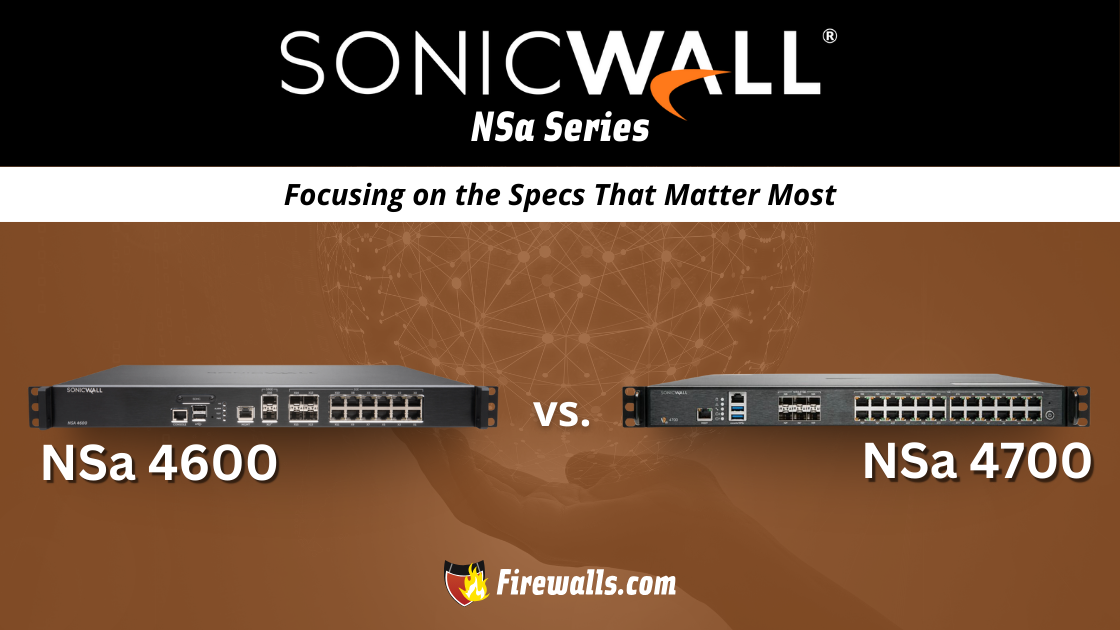
In the debate of SonicWall NSa 4600 vs NSa 4700, there are a few notable differences that are important to point out. On another front, you’d be hard-pressed to find a new SonicWall NSa 4600, as they’ve been discontinued in light of the NSa 4700.
Firewall manufacturers tend to dish out new models every three to five years for several reasons. A lot of this stems from advancements in tech in network firewall security as a whole. Once the SonicWall NSa 4700 hit the market, it was seen as a step up compared to what the 4600 could bring to the table.
Although both firewall models offer plenty of support in performance, one is bound to be a better scalable solution. This article takes a comprehensive look at SonicWall NSa 4600 vs NSa 4700 to help guide your journey in modern business network security.
Comparing the SonicWall NSa 4600 vs NSa 4700
At a glance, you’ll find that both firewall generations are capable of a lot of the same features. When it comes to the comparisons, a lot of this comes down to particular specs. Taking a look at the 4700, you’re guaranteed high-performance network security with longevity in mind. It’s also considered a mid-range solution, making it a great option for growing businesses at various stages.
However, the NSa 4600 is still part of the same series of firewalls, but the lengths of its specs are a bit more limited. More than viable for small businesses, the 4600 wouldn’t be the most scalable option in comparison.
You’ll also want to take note of the fact that the last purchase date for the 4600 was back in 2021. However, support for the older model is ongoing until March of 2026. Nevertheless, in terms of cybersecurity, that isn’t too far away, and it can help to start considering what an upgrade might look like.
What is the SonicWall NSa 4600?
Even though both SonicWall firewalls are built for similar business objectives, it’s vital to break down the specs that matter most. On the surface, the robust security features of the 4600 are undeniable. Then again, considering its trajectory toward its end of life, it wouldn’t be a great initial investment.
Here are a few specs to pay attention to about the SonicWall NSa 4600:
- Firewall Throughput: 6.0 Gbps
- IPS Throughput: 2.0 Gbps
- Anti-malware Throughput: 1.1 Gbps
- Max Connections (SPI): 1,000,000
- Connections per Second: 40,000

It’s understandable if this sounds like more than enough, but you should also wonder why you’re being ushered into the 4700. Through a combination of positive upsides in cybersecurity and scalability, the benefits of the NSa 4700 are hard to ignore in this situation.
What is the SonicWall NSa 4700?
Built to support 1,000 to 2,500 users, the NSa 4700 offers network security capabilities that are more than prepared for the future. It also comes with flexible licensing solutions that allow you to get more specific with available feature sets.
Here are a few comparable specs with the NSa 4700:
- Firewall Throughput: 5.5 Gbps
- IPS Throughput: 10 Gbps
- Anti-malware Throughput: 9.5 Gbps
- Max Connections (SPI): 4,000,000
- Connections per Second: 115,000

It might be a little shorter in regard to overall firewall throughput, but it clearly exceeds in every other bullet point. This acts as a great starting point for mid-sized businesses that are looking for a solution that’s built for long-term network security demands.
Sonicwall NSa 4600 vs NSa 4700 Firewall Comparison
Aside from the few details mentioned above, the various specs between the two firewall models only get increasingly unique. From a business ownership or even an IT perspective, the benefits of the NSA 4700 are hard to argue with. At the same time, showing how it differs from the 4600 helps provide context for what makes it a stronger choice.
| Specification | NSa 4600 | NSa 4700 |
|---|---|---|
| Firewall Throughput | 6.0 Gbps | 5.5 Gbps |
| Application Inspection Throughput | 2.0 Gbps | 1.0 Gbps |
| Max Connections (SPI) | 1 million | 4 million |
| Connections per Second | 40,000 | 115,000 |
| Site-to-Site VPN Tunnels | 3,000 | 4,000 |
| Operating System | SonicOS 6.5 | SonicOS 7 |
| Power Supply | 250W | 350W |
| Interface | 2 x 10-GbE SFP+ 4 x 1-GbE SFP 12 x 1 GbE 1 GbE Management Port 1 Console | 6 x 10G/5G/2.5G/1G (SFP+) 24 x 1GbE 2 USB 3.0 1 Management Port 1 Console |
Overall, the SonicWall NSa 4700 brings a bit more strength to your company’s network security. Looking back at the 4600, it still has a bit of a run-to-go, but it’ll only be a few years before users need to upgrade.
The Bottom Line
Comparing the two SonicWall NSa firewalls isn’t meant to cause concern but to provide a little hindsight into what’s to come. The reality of cybersecurity threats isn’t something that can be taken lightly, and reliable security means considering the features your business needs.
In this case, the SonicWall NSa 4700 is the best-case scenario for mid-sized businesses that are expecting to grow. The Firewalls team is here to guide you through any questions or concerns you might have, so don’t hesitate to reach out when you’re ready.