
Although emailing has been around for decades, it still remains a critical component of business operations and communication channels. It has definitely evolved immensely over the years, but so have the potential security threats. In regard to SonicWall email security solutions, businesses have a few core options to choose from.
Between hosted email security and on-premise appliances, you’re going to encounter quite a few differences. With host email security, you’re working with a cloud-based solution that’s known for scalability and reduced administrative overhead. Looking at the on-prem side, it delivers full control over deployment, management, advanced threat protection, and more.
For businesses looking to choose between the two, it’s all about comparing SonicWall security options to find what works best for you. This article pits the two together to showcase the core differences and strengths in SonicWall email security solutions.
An Overview of SonicWall Email Security
On the surface, email security protects communications from unauthorized access. The same can be said about data loss and cyber threats as a whole. Not only is it an essential for business continuity, but it’s a must to face the complexity of modern cybersecurity threats.
From the bird’s eye view of the situation, organizations need layered protection for their networks, and email security is a part of that. Whether it’s cloud-based, multi-tenant protection, or on-premise control you’re looking for, SonicWall products have you covered.
What is SonicWall Hosted Email Security?
The strong suit here with hosted email security is the capabilities in cloud-based protection. More specifically, this means a multi-tenant, cloud-hosted service that safeguards tools like G Suite, Office 365, and even on-prem servers.
Here are a few key highlights that make hosted email security unique:
- Eliminates the need for a physical SonicWall network security appliance
- All updates, threat intelligence, and maintenance are handled in the cloud
- Supports full multi-tenancy
- Provides automatic email continuity through a secure web portal, even during outages
- Leverages SonicWall Capture Threat Network and RTDMI to instantly block zero-day threats

Keep in mind, this is just a glimpse into what it brings to the table. However, these points offer good insight into what separates it from an on-prem antispam appliance for email.
What is the SonicWall On-Prem Email Security Appliance?
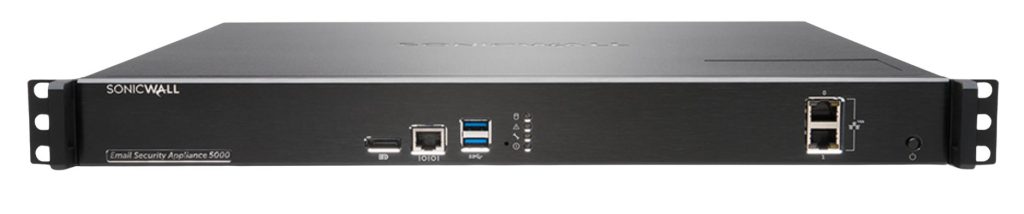
While hosted email security is great from more than one angle, that doesn’t mean physical appliances are a thing of the past. If you go with an on-prem solution, you get the promise of multi-layered protection, flexible deployment options, and a lot more.
Here’s a quick look at how on-prem solutions compare to those same points above:
- Requires physical, virtual, or software-based deployment
- Updates, signature databases, and maintenance are applied manually or on a schedule
- Multi-tenancy is possible but requires manual configuration
- Email continuity is dependent on local server uptime
- On-prem solutions rely on local threat intelligence and scheduled updates
While there are ups and downs to any email security solution, it’s helpful to align your choice with your unique business needs. One of the best ways to do this is to stack features and capabilities between the two in a digestible format.
Comparing Hosted Email Security vs On-Premise Appliances
Whereas some businesses might prefer cloud-based solutions, others prefer to work with hardware they can put their hands on. There is validity to both sides, but this also comes with the consideration of their unique features and capabilities. In the table below, you’ll find how these solutions stack up against each other across several important categories.
| Key Category | Hosted Email Security | On-Prem Appliance |
|---|---|---|
| Deployment | Cloud-based, multi-tenant service, no on-prem hardware needed | Multi-layer scanning of inbound/outbound attachments, URLs, stops ransomware, phishing, BEC, spoofing, spam, and viruses |
| Threat Protection | Scans attachments and URLs in the cloud; stops ransomware, phishing, BEC, spoofing, spam, and viruses | Centralized or split-mode management, multi-LDAP sync, spam delegation, requires IT management and maintenance |
| Management & Administration | Centralized multi-tenant management, easy provisioning, automatic updates, and minimal IT overhead | Scale via additional appliances, virtual instances, or clustering; upfront costs for hardware |
| Scalability | Subscription-based, easily scale users without hardware changes, predictable costs | Optional continuity with Emergency Inbox and spooling; depends on deployment and configuration |
| Email Continuity | 24/7 web-based Emergency Inbox during outages; includes email spooling | Upfront hardware cost; ongoing maintenance, updates, and optional subscriptions |
| Cost & Maintenance | Monthly and annual subscriptions; no hardware |
It all comes down to what works best for your network security infrastructure. This will undoubtedly require a few stages of decision-making for some companies, which is why this kind of fine print matters.
The Final Word
It’s not so much about one over the other, but identifying which feature set aligns best with your business needs and objectives. SonicWall is a network security company you can rely on, and their hosted and on-prem email security solutions are just a few of many examples. Overall, SonicWall email security is diverse, no matter which way you look at it.
Hosted promises a cloud-based option with minimal IT overhead. On-premise appliances are better for full control deployment and management, and are ideal for more complex network environments. For a little more guidance on the subject, reach out to us at Firewalls for industry expertise on which email security solution is best for your operation.