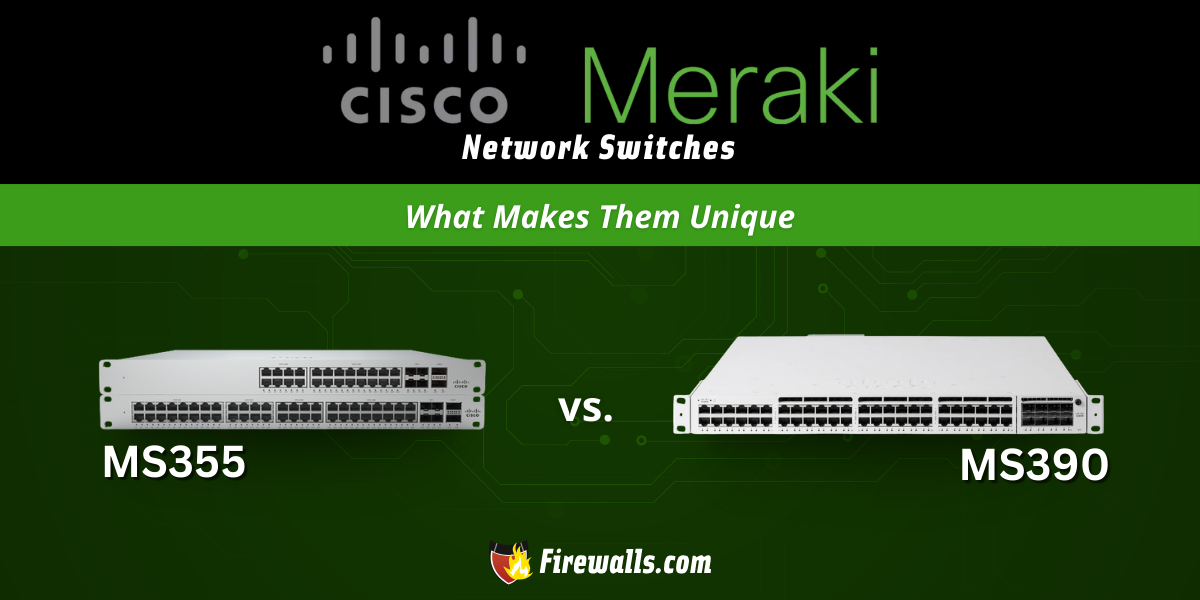
Regardless of which Meraki switch you’re looking at, they’re created with high performance in mind. However, narrowing this down to Meraki MS355 vs Meraki MS390, there are definitely a few differences involved.
The same can be said about their similarities, but when making a choice for your business network, you want to end up with the right one. For this article, you’re getting a look at Meraki MS355 vs Meraki MS390, using their specs as a guide on which path you should take.
Comparing Meraki Switch Options
Choosing the right network switch is a crucial component of building a reliable and high-performance network. With Cisco Meraki switches, businesses get the benefits of simplified deployment, management, and scalability all in one.
They do well to support modern network demands in more ways than one. Whether it’s your workstations, servers, or Wi-Fi access points, they bring a lot to the table. Better yet, Meraki MS switches are fully cloud-managed, which eliminates the need for any traditional command-line configuration. Nevertheless, understanding the differences between one model and the next is how you end up with the right choice for your specific network.
What is the Meraki MS355?
A cloud-managed and stackable multi-gigabit switch, the Meraki MS355 is a great choice for enterprise and campus networks. With its plug-and-play setup and centralized dashboard control, the MS355 promises granular network visibility and remote diagnostics.
Here are a few details when it comes to the specifications:
- Switching Capacity: Up to 688 Gbps
- Stacking Bandwidth: 400 Gbps
- Uplink Interfaces: 10/40G
- Access Switching: Up to 48 ports
- mGig Ports: Up to 24

This alone is a good look at robust performance, and would definitely be more than enough for many organizations. However, stacked against the MS390, you’ll gain a better understanding of the target markets for each of these Meraki products.
What is the Meraki MS390?
Built with more demanding enterprise applications in mind, the Meraki MS390 is an ideal choice for high-bandwidth environments. Utilizing fast stack convergence for uninterrupted network operations and scalable, intuitive traffic segmentation, there’s a lot to appreciate here.
Take a look at a few comparable specs in the list below:
- Switching Capacity: Up to 640 Gbps
- Stacking Bandwidth: Up to 480 Gbps
- Uplink Interfaces: 10/40G
- Access Switching: Up to 48 ports
- mGig Ports: Up to 48

The differences may seem minimal, but it’s the bigger picture you need to think about when it comes to your network. Clearly, these switch models share a few similarities, but that’s why it’s important to continue digging for where the differences are.
Meraki MS355 vs Meraki MS390
No one likes to read line by line through the full datasheets, as this can make the decision-making process a bit convoluted. That’s why we’ve put together a brief yet informative table to help you avoid the noise.
| Specifications | Meraki MS355 | Meraki MS390 |
|---|---|---|
| Max Switching Capacity (Gbps) | 688 | 640 |
| Max Stacking Bandwidth (Gbps) | 400 | 480 |
| Hardware Stack Port | 2 x 100G | 2 x 120G |
| UPoE Capable | Yes, up to 740W | Ye,s up to 645W |
| Forward Rate | Up to 512 mpps | Up to 476.19 mpps |
| Interface | 24 x 100M/1G/2.5G/5/10G Ethernet RJ45 with auto negotiation and autoMDIX3 24 x 1G Ethernet RJ45 2 x 40G QSPF+ or 4 x 10G SFP+ uplinks 2 x 100G QSFP28 stacking ports | 48 x 100M/1G/2.5G/5G Modular 10/40GbE SFP+ and QSFP+ uplinks 2 x 120G hardware stack ports |
It’s evident that both of these Meraki products give and take depending on the category you’re looking at. Also, it’s important to keep in mind that many of these specs vary depending on the specific model you’re looking at. There are several options on both sides, and many of these specs highlight the max capacity you can find.
The Bottom Line
In the context of Meraki MS355 vs Meraki MS390, you’re getting high-performance, cloud-managed networking on both sides. However, whereas the MS355 excels in a higher switch capacity, the MS390 focuses on a higher stacking bandwidth. Choosing between the two is based on your current and long-term network demands.
In short, the MS355 is great for high-density access, and the MS390 is optimized for resiliency, scalable security, and advanced enterprise features. For a little more expert guidance on the topic, our team members at Firewalls.com are always on standby. Hop on a call or send us a message for straightforward assistance on which of these Meraki MS switches are best for your needs.
FAQ
What are the Main Differences Between the Meraki MS355 and MS390?
The MS355 does well with high-density access, with up to 24 mGig ports and higher switching capacity. With the MS390, you’re getting a stronger focus on higher stacking bandwidth, advanced resiliency, and scalable security features.
Can Both Switches be Managed Through the Meraki cloud dashboard?
Yes, both the Ms355 and MS390 are fully cloud-managed, allowing for centralized visibility, easy configuration, and remote troubleshooting. This is all without requiring a command-line setup.
Which Switch is Better for High Bandwidth Wi-Fi 6 Deployments?
Both support Wi-Fi 6 access points, but the MS390 may be the better option for environments that need better resilience. This also goes for businesses that need fast stack convergence and scalable traffic segmentation.
What is the Stacking Capacity of Each MS Switch?
The MS355 offers up to 400 Gbps stacking bandwidth, while the MS390 provides higher stacking capacity at 480 Gbps for demanding enterprise networks.
Are These Switches Suitable for Large Enterprise Networks?
Yes, both switches are designed for enterprise and campus environments. However, the choice really depends on whether your priority is high-density access or advanced security and resiliency features.