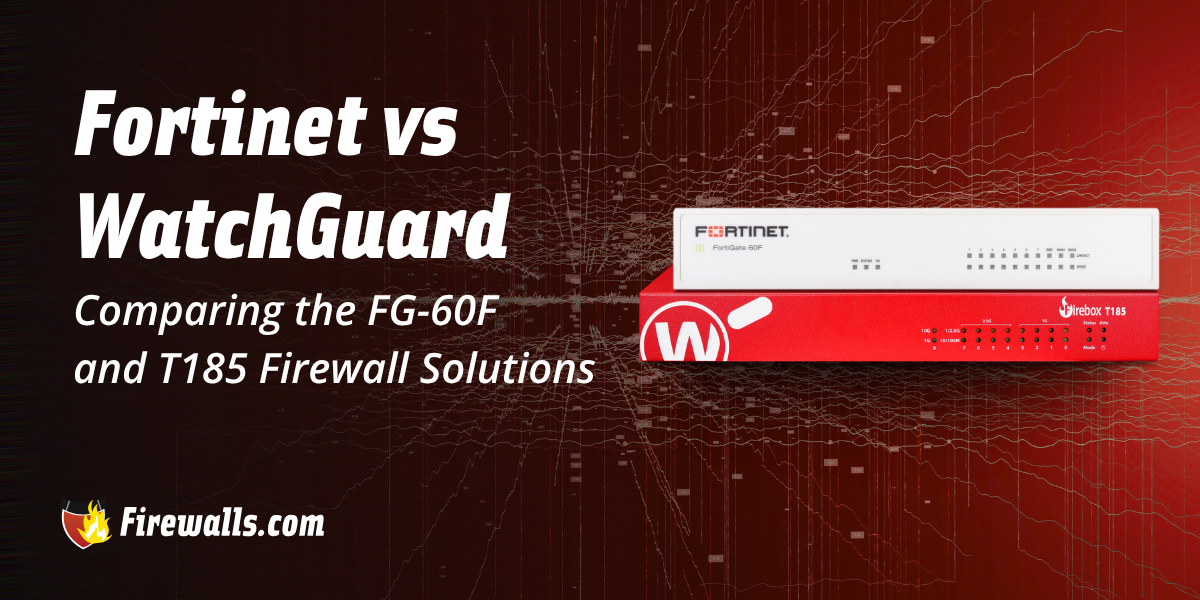
For those going down the path of choosing the right firewall, it can seem like you have a never-ending list to choose from. Moreover, it can be hard to know which models to compare if you don’t know what you’re looking for. In the context of Fortinet vs WatchGuard firewalls, both manufacturers have many excellent options to choose from.
More specifically, FG60F vs T185 focuses on comparing small business firewall solutions, each with their own design priorities. This article compares the two firewalls to help guide you on which direction would be best for your business network security.
Key Takeaways:
- The FG-60F and T185 are both designed for small business and branch office firewall deployments
- Fortinet is known for high performance, centralized management, and integrated security services
- WatchGuard T185 leans into modular hardware, scalability, and flexible network expansion options
- FG-60F generally delivers stronger throughput for more performance-driven environments
- The best choice depends on whether a business values performance efficiency or long-term infrastructure flexibility
A Firewall Comparison at a Glance
With the Fortinet FG-60F, you’re getting network support that’s suitable for small offices and branch environments. This means a user capacity of 25 to 50 and plenty of high-performance throughput.
On the other hand, the WatchGuard firewall T185 is highly configurable, built with flexibility in mind. The short version is that Fortinet focuses on performance and integrated security, while WatchGuard excels with modular scalability and hardware flexibility.
What is the Fortinet FG-60F?
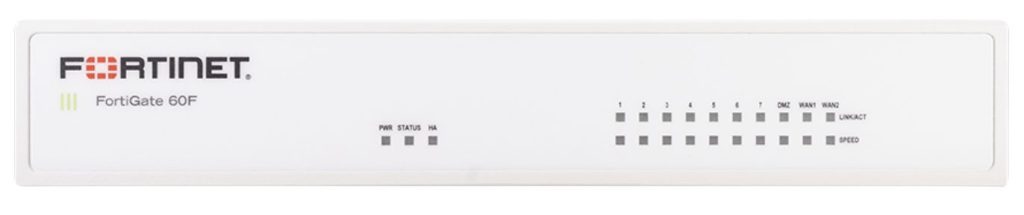
A next-generation firewall built for the likes of small businesses, this particular model comes with the promise of 10 Gbps firewall throughput. It’s also supported by Fortinet’s FortiOS, which enables centralized and simplified network security management.
Here’s a quick look at the specs:
- Firewall Throughput: Up to 10 Gbps
- IPsec VPN Throughput: 6.5 Gbps
- SSL-VPN Throughput: 900 Mbps
- App Control Throughput: 1.8 Gbps
- Concurrent Sessions: 700,000
Of course, the firewall offers a lot more than this alone, but it’s definitely a good starting point for comparing metrics. Always remember that your decision between the two should be based on what aligns best with your business. Both of these firewalls are stellar options, but you have to dive into the features and capabilities to know which is right for you.
What is the WatchGuard Technologies Firewall T185?
The T185 from WatchGuard is a desktop firewall that’s also great for small business network security. It’s hailed for its highly configurable design, making it an adaptable design for those who prioritize flexibility.
Check out the specifications below for a quick comparison:
- Firewall Throughput: 7.9 Gbps
- VPN Throughput: 2.2 Gbps
- UTM Throughput: 1.83 Gbps
- IPS Throughput: 2.4 Gbps
- Concurrent Connections: 3,850,000
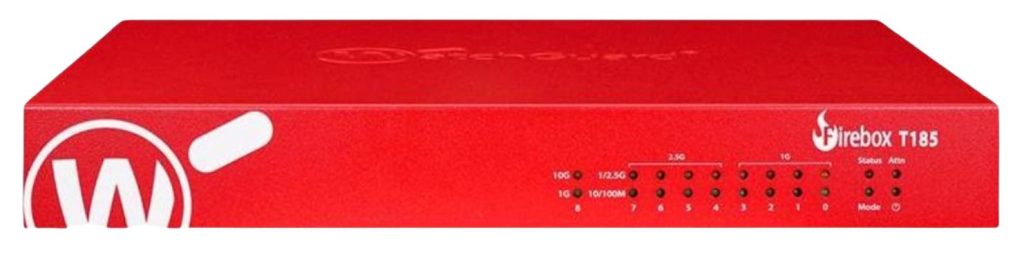
It’s also worth noting that the T185 comes with SFP+ fiber connectivity, in addition to multiple Ethernet interfaces. It also delivers enhanced BOVPN performance, which works to improve secure site-to-site connections.
FortiGate FG-60F vs WatchGuard Firewall T185 Firewall Comparison
Without a streamlined understanding of what these firewalls are capable of, you’re going to have a hard time making a choice. The table below offers the overview you need to compare these firewalls side by side across several crucial categories.
| Specification | Fortinet FortiGate 60F | WatchGuard Firebox T185 |
|---|---|---|
| Target Use Case | Small businesses and branch offices | Branch offices, retail, and high-demand sites |
| IPS / Threat Protection | IPS: 1.4 Gbps / Threat Protection: 700 Mbps | IPS: 2.4 Gbps / UTM: 1.83 Gbps |
| Firewall Throughput | Up to 10 Gbps | Up to 7.9 Gbps |
| SSL / HTTPS Inspection | SSL Inspection: 630 Mbps | HTTPS: 1 Gbps |
| VPN Performance | IPsec VPN: up to 6.5 Gbps | VPN: Up to 1.14 Gbps |
| Interfaces | 2 x GE RJ45 WAN 1 x DMZ Ports 5 x GE RJ45 Internal Ports 2 x GE RJ45 FortiLink Ports 1 x USB Ports 1 x Console (RJ45) | 4 x 1 GbE 4 x 2.5 GbE 1 x SFP/SFP+ |
| Advanced Features | FortiOS, FortiGuard AI security, SD-WAN included | TLS decryption, proxy firewall, WatchGuard Cloud reporting |
It can be a lot to take in, but at the end of the day, both firewalls are excellent security solutions for small and growing businesses. In the same vein, you don’t have to handle all of the decision-making by yourself. Working with managed services from security providers can make sure you end up with the right hardware, long-term maintenance, and expertise you need.

The Bottom Line
Regardless of which side you lean towards with Fortinet vs WatchGuard, your business network will be in good hands. Where FortiGate emphasizes performance and unified security architecture, WatchGuard offers expandable ports, fiber connectivity, and seamless scalability.
In the same vein, many of the benefits of the two overlap. Both firewalls are excellent small business firewall solutions, but your choice depends on long-term network demands and your growth strategy. We’re here if you need us, so reach out to learn more about both of these firewall options and how they fit into your business network.
FAQ
What is the Core Difference Between Fortinet FG-60F and WatchGuard T185?
The Fortinet FG-60F focuses on strong performance and unified security, while the WatchGuard T185 leans more into hardware flexibility and scalability.
Which Firewall Offers Better Performance?
The FG-60F generally delivers higher firewall and VPN throughput, making it stronger for performance-focused environments.
Which Firewall is Better for Growing Networks?
The WatchGuard T185 is better suited for growing networks due to its expandable ports and fiber connectivity options.
Are Both Firewalls Suitable for Small Businesses?
Yes, both the FG-60F and T185 are designed for small businesses and branch office environments with different priorities.
Do Both Firewalls Support Advanced Security Features?
Most definitely, as both include advanced protections like intrusion prevention, threat detection, and encrypted traffic inspection capabilities.