Through high-performance edge and hybrid network security, the FortiGate 401F is more than robust as a business firewall solution. High throughput capability is one thing, but you’re also getting AI/ML-driven protection, ZTNA support, and much more.
While this isn’t your only option in Fortinet FortiGate security solutions, the 401F is definitely worth taking a closer look at. In this article, you’ll get a technical overview of the 401F from Fortinet and the information you need to determine if it’s right for your network.
Key Takeaways:
- The 401F from FortiGate combines high-performance throughput with advanced next-gen firewall security capabilities
- It leverages AI/ML-driven FortiGuard services for real-time threat detection and prevention
- Built on FortiOS and the Security Fabric, it enables unified policy control and centralized network visibility
- The platform supports secure SD-WAN, ZTNA, and network segmentation for modern hybrid environments
- Designed for enterprise-scale workloads, the 401F delivers strong VPN capacity, session handling, hardware-accelerated performance, and more
What is the Fortinet FortiGate 401F Firewall?
Within the lineup of Fortinet firewalls, the FortiGate 401F is a next-gen solution built to handle modern enterprise traffic and security. This means an extension of traditional firewall capabilities.
The list below has a quick overview of what the 401F firewall is known for:
- Built on FortiOS, utilizing unified policy control and consistent enforcement
- Fully integrated into the Fortinet Security Fabric for coordinated threat intelligence
- Optimized for hybrid working environments
- Supports scalable, high-performance secure networking across distributed infrastructures
I always feel it’s important to note that the fine print here matters more than just a surface-level overview. Not only is it important to know what kind of hardware you’re working with, but also to understand how that compares to your real-world network demands.
The 401F Fortinet NGFW at Its Core
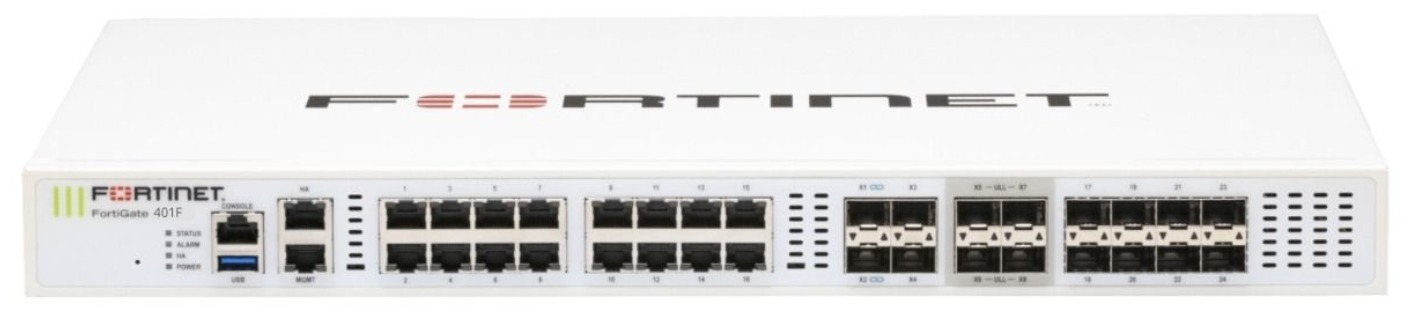
Any time I take a glance at the FortiGate 401F datasheet, it’s made obvious that this is a sturdy piece of firewall hardware. From 10 Gbps NGFW throughput to Fortinet’s SPU architecture, and a lot more, the 401F is made for resilience and reliability. Take a look at the table below to see what it’s capable of from more than one angle.
| Specifications | FortiGate 401F |
|---|---|
| IPS Throughput | 12 Gbps |
| NGFW Throughput | 10 Gbps |
| Threat Protection Throughput | 9 Gbps |
| Firewall Throughput | Up to 79.5 Gbps |
| IPSec VPN Throughput | 55 Gbps |
| SSL-VPN Throughput | 3.6 Gbps |
| Concurrent Sessions | 7,800,000 |
| New Sessions per Second | 500,000 |
| Interfaces | 16 x GE RJ45 ports 8 x GE SFP slots 4 x 10GE SFP+ slots 4 x 10 GE SFP+ ultra low latency slots 2 x GE RJ45 management/HA ports 1 x USB port 1 x RJ45 console port |
All in all, the 401F comes with the promise of improved inspection speed, encryption handling, overall traffic processing efficiency, and the list goes on. However, I always make it a point to business owners and IT teams that the scope of security features matters just as much.
Security Capabilities of FortiGate Firewalls
There isn’t a single lane to the security features behind the FortiGate 401F. It’s a lot more feature-rich than you might expect. A few leading examples in my opinion include AI/ML-powered security services, centralized policy management, and the Fortinet Security Fabric, to name a few.
For the most part, the aim of the 401F’s security features is to deliver a coordinated approach to your network. This also includes the support of layered features like secure SD-WAN, universal ZTNA, and network segmentation.
Secure SD-WAN for Hybrid Networks
SD-WAN might sound like common terminology to most, but it still helps to understand the specifics behind the 401F. In this case, it’s more than just centralized visibility and control.
It gives you what you need to manage policies and monitor app performance across multiple locations. Moreover, you’re getting support for application-aware routing. This optimizes traffic paths based on your network conditions.
Universal ZTNA Enforcement
If you aren’t making use of it already, then I’d say it wouldn’t hurt to get up to speed on the benefits of Zero Trust Network Access (ZTNA). Not only does the 401F support this strategy, but it also applies consistent user-to-app access controls, regardless of the app’s location.
In addition to that, you get the certainty of continuous verification before anyone gets granted app connectivity. It’s a crucial component to securing access, whether it’s on-prem or in cloud environments.
Network Segmentation and Lateral Threat Prevention
Separating users, devices, applications, and workloads, network segmentation is something modern businesses shouldn’t overlook either. This helps to reduce the chance of threats moving laterally across your network.
So, even if a risk does make its way through, segmentation keeps it contained within isolated segments. What I also like to highlight here is that, with the 401F, it also comes with VXLAN support, meaning scalable segmentation across distributed networks.

Understanding the Real-World Demands of Your Business Network
Even with all of the specs laid out, you might still wonder if it’s aligned with your exact network needs. However, if you get a grasp on how users, data, and applications move across your network, it’s a bit easier to understand where the FortiGate 401F can be applied.
Here are several core details to keep in mind when it comes to your company’s cybersecurity:
- Most modern businesses work with cloud services, remote users, SaaS apps, and distributed locations, which makes for a lot of entry points
- Network traffic is bound to increase as your organization grows over time
- Your security infrastructure should offer protection without creating new bottlenecks along the way
- If you’re dealing with high levels of encrypted traffic, then you’ll want strong SSL inspection
- Throughput, app visibility, and VPN performance are vital factors when evaluating firewall solutions
- Reliable network performance has a direct impact on your operation’s productivity and overall network experience
Overall, no one can really argue with the fact that effective security solutions are a must for any modern business. In the same vein, the choice you make should combine scalability, centralized management, and thoroughly integrated threat protection.
Here’s The Bottom Line
Regardless of how I break it down, the FortiGate 401F promises enterprise-grade performance on more than one front. You can see this across its strong throughput, robust security features, efficient traffic handling, and more.
This is a Fortinet NGFW that easily goes beyond raw specs alone, combining advanced security with the operational efficiency every modern company needs. For those who are still on the fence here, have a chat with one of our experts at Firewalls.com, and we’ll talk you down the side that’s perfect for your operation.
Frequently Asked Questions
How Does the FortiGate 401F Support Hybrid Network Environments?
The 401F from Fortinet supports hybrid networks by combining secure SD-WAN, centralized policy control, and cloud-ready security.
What Hardware Accelerates Performance on the FortiGate 401F?
You can find this in the Fortinet SPU architecture, including the NP7 and CP9 processors, to offload and speed up security processing.
Can the FortiGate 401F Scale for Growing Enterprise Traffic?
Most definitely, as it supports millions of concurrent sessions and high new-session rates, making it more than suitable for expanding networks.
How Does the FortiGate 401F Improve Visibility Into Network Activity?
It provides deep inspection of apps, users, and devices through the integrated FortiOS and Security Fabric.
What Role Does the FortiGate 401F Play in Preventing Lateral Attacks?
The firewall makes use of network segmentation and policy-based controls to isolate traffic and prevent the spread of threats across systems.