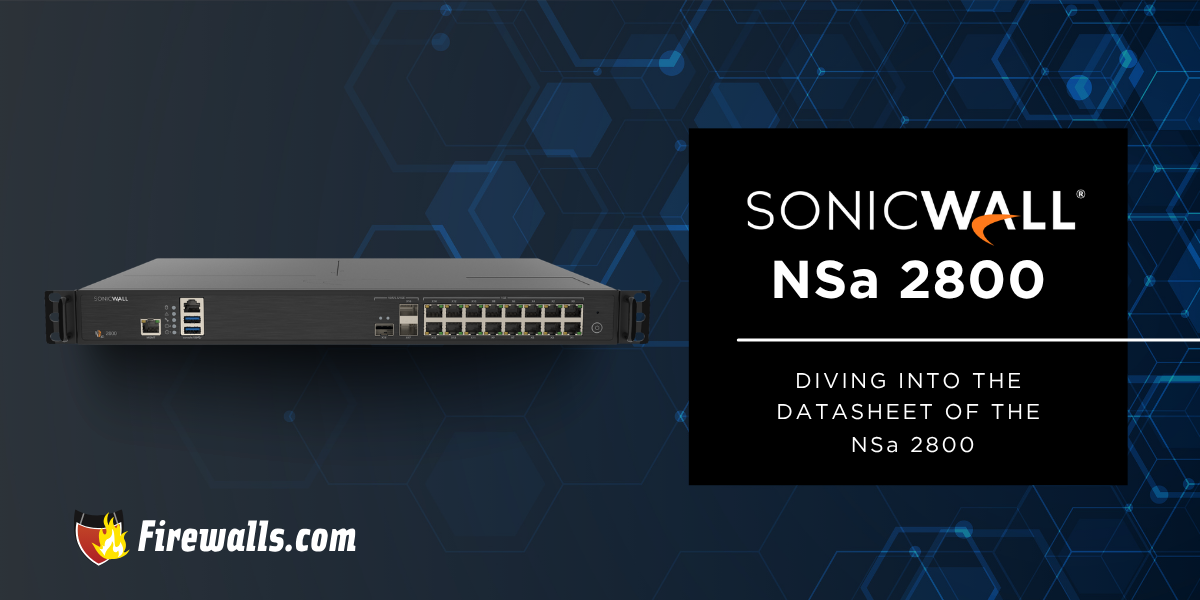
Like any SonicWall network security appliance, the NSa 2800 is one of several reliable options from their Gen 8 lineup. With this specific model focusing on medium to distributed enterprises, you’re getting a lot of wiggle room here.
Between SonicOS 8, multi-gigabit threat prevention, and a sizable list of advanced features, the SonicWall NSa 2800 is stacked to say the least. This article dives into the datasheet details, singling out some of the most important specs and features this firewall has to offer.
Key Takeaways:
- Supports 200-500 users with up to 8 Gbps firewall throughput
- Powered by SonicOS 8 for simplified management and network visibility
- Delivers layered security with ATP, RTDMI, RFDPI, TLS 1.3, and more
- Combines SD-WAN, VPN, and dynamic routing into a singular platform
- Designed for medium businesses, distributed enterprises, and campus networks
What is the SonicWall Network Security Appliance 2800 Model
Featuring support for 200 to 500 users, the NSa 2800 is a powerhouse when it comes to the ranks of next-gen firewalls. You can see this from many angles, whether it’s the substantial user support, streamlined management and visibility, and the list goes on and on.
Here’s a brief overview of what you’re getting out of the SonicWall NSa 2800:
- Built for scalable threat prevention
- Delivers up to 8 Gbps of firewall throughput
- Supports up to two million max connections
- Ideal for mid-sized companies, distributed enterprises, campus networks, and edge protection
- Secures your network, apps, users, and connected devices with a layered security model

Part of what I really like about the 2800 is that it serves as an excellent middle-ground growth period for organizations. When you’re in that in-between stage of being brand new and going full-scale enterprise, the 2800 can back your network with years of excellent support.
SonicWall NSa 2800 Firewall Hardware Specs and Architecture
If you want to get to the point about this firewall device, then you should start with some of the most relevant specs first. A lot of this has to do with various throughput and session capabilities as well as interface details. I’ve put the bulk of this in the table below to help you sort through a lot of the technical noise.
| Specifications | SonicWall NSa 2800 |
|---|---|
| Firewall Throughput | 8 Gbps |
| Threat Prevention Throughput | 6 Gbps |
| App Inspection Throughput | 7 Gbps |
| IPS Throughput | 7 Gbps |
| Anti-malware Inspection Throughput | 6 Gbps |
| TLS/SSL Inspection & Decryption Throughput | 1.8 Gbps |
| IPSec VPN Throughput | 5.5 Gbps |
| Connections per Second | 50,000 |
| Max Connections (SPI) | 2,000,000 |
| Storage | 128 GB M.2 |
| Interfaces | 16 x 1GbE 3 x 10G SFP+ 2 x USB 3.0 1 x Console 1 x Management port |
Moreover, you get the constant availability you need due to the dual power support and redundancy capabilities. The full scope of this SonicWall next generation firewall can be a bit overwhelming on paper, which is a testament to its rightful place in modern-day business networks.
SonicWall Next Generation Firewall Features from SonicOS 8
In more ways than one, SonicOS 8 comes with improvements on visibility, security management, and overall operational efficiency. Notable features under Gen 8 include things like SD-WAN, dynamic routing, high availability, VPN functionality, and much more. Whether it’s simplified management or advanced security features driving your decision-making, the NSa 2800 has it all.
Simplified Management with SonicOS 8
Aside from the modern interface, SonicOS 8 is built with easier administration and improved workflow in mind. Moreover, you’ll likely only need centralized management through SonicWall’s NSM. However, other options are available as well, such as Web UI, CLI, and REST APIs, to name a few.
The benefit of zero-touch deployment tends to speak for itself, and the entire experience with the NSa 2800 comes with minimal complexity for IT teams. Although the simplicity is great when it comes to management, the advanced networking and security features are anything but in the best way possible.
Advanced Networking and Secure Connectivity Features
For those operating in branch offices or cloud environments, the secure SD-WAN capabilities of the 2800 are pretty crucial. You’ll also find the firewall supports multiple dynamic routing protocols, like RIP, OSPF, and BGP.
Businesses also gett better network resilience and overall uptime thanks to the layer 4-7 high availability features. Without getting too technical, the NSa 2800 does a great job of consolidating firewall security, routing, and connectivity into a simplified platform.
Centralized Management Across the SonicWall Ecosystem
Here’s another point to consider: this firewall device is great on its own, but it easily integrates with the entire SonicWall ecosystem as well. Admins can manage the entire firewall operation from one place, even when working in distributed environments.
This unified management not only improves security and visibility but also makes it easy to integrate other SonicWall layers like switches or WAPs. Having this kind of centralized control is a must-have component to scaling your security stack alongside your business operations.

Security Services and Threat Protection Capabilities of the NSa SonicWall 2800
Utilizing a layered security approach, the 2800 goes beyond what’s needed for most of today’s cyber threats. Take a quick look at the list below to get a better visual on what this firewall device is bringing to the table.
- Capture Advanced Threat Protection (ATP) for cloud-based sandboxing
- Real-Time Deep Memory Inspection (RTDMI) to identify malware hidden in memory
- TLS 1.3 inspection, which allows the firewall to analyze encrypted traffic for hidden threats
- Reassembly-Free Deep Packet Inspection (RFDPI) for traffic inspection without compromising performance
- Intrusion prevention to detect and stop network-based attacks
As you might expect, the list definitely doesn’t stop there. Other angles I like to highlight here include URL filtering, DNS security, Geo-IP filtering, and even botnet protection. It’s this approach to layered and integrated security that’s going to do much more than keep your network protected. There’s a combination of supportive hindsight, ease of use and seamless management that makes the SonicWall network security appliance such a great option.
Let’s Wrap This Up
At the end of the day, the NSa 2800 offers the combined security layers businesses need for their networks in this day and age. These specs and features aren’t suggestions but a necessity created out of the reality of modern cyber threats.
If you’re looking for the right firewall hardware, the 2800 is a SonicWall network security appliance that offers a stellar middle ground. Enterprise-grade security in a model that’s built for growing companies. From finding the right hardware to setup and even helping you manage it all, don’t forget to reach out to us at Firewalls.com for any questions or concerns about your network.
Frequently Asked Questions
What Type of Business is the SonicWall NSa 2800 Good For?
Realistically, the SonicWall NSa 2800 is built for medium-sized companies, distributed operations, and organizations that need enterprise-grade protection.
How Many Users Can the NSa 2800 Support?
This particular firewall model is rated to support anywhere from 200 to 500 users on a network.
What is the Firewall Throughput of the NSa 2800?
This SonicWall network security appliance promises up to 8 Gbps of firewall throughput.
Are There Multiple Security Features Included with the NSa 2800?
Yes, the NSa 2800 includes security features like Capture ATP, RTDMI, app control, DNS security, Geo-IP filtering, TLS 1.3 encrypted traffic inspection, and more.
How Does the NSa 2800 Firewall Support Centralized Management?
It runs on SonicOS 8 and supports centralized management through SonicWall’s NSM, along with other options like Web UI, CLI, and REST API access.