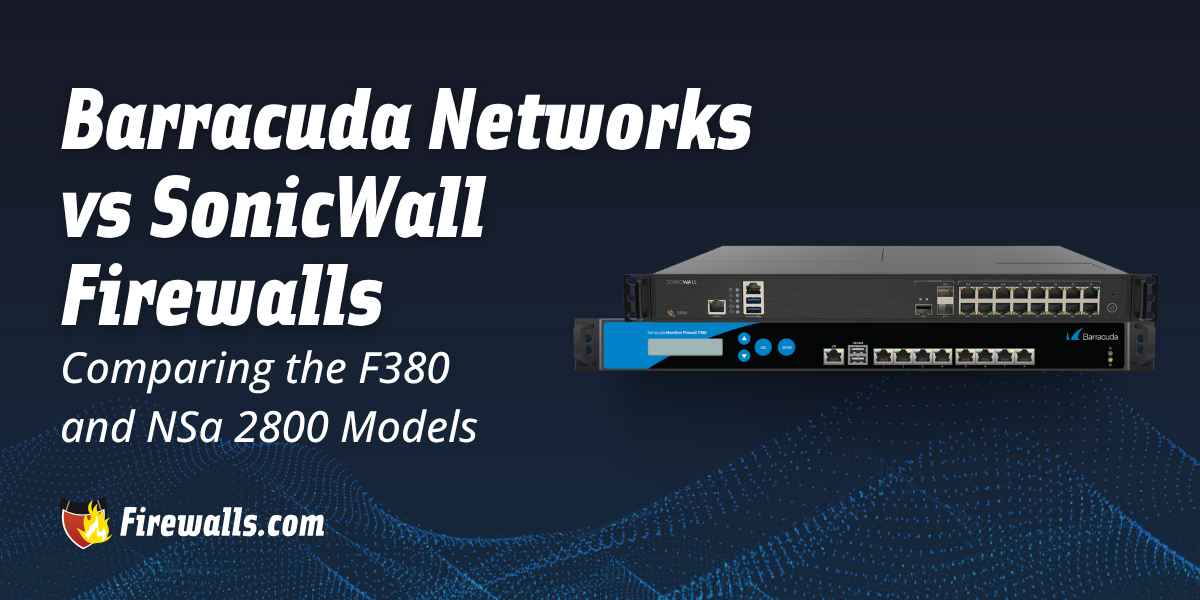
Before you start picking sides here, it’s always crucial to remember that Barracuda Network firewalls and SonicWall NSa are entirely different manufacturers. This is an important distinction, as they both bring plenty of value to the table; the fine print simply looks a bit different.
Moreover, comparing Barracuda F380 and NSa 2800 comes with quite a bit to look forward to on both sides. This article offers a direct comparison of leading specs and features that’ll help you create a better security stack for your network moving forward.
Key Takeaways:
- Compare the Barracuda F380 and NSa 2800 across key specs and capabilities
- See how each firewall approaches security for distributed and cloud-connected business networks
- Review throughput, VPN, IPS, threat protectiona nd connection capacity side by side
- Examine interface options and other hardware details that can affect network deployment
- Use the differences in capacity and design to identify the better fit for your network
Exploring Barracuda Network F-Series and SonicWall NSa Series Firewalls
When it comes to F-Series Barracuda security, you can easily protect users, devices, and workloads across cloud-connected environments. This is also a great approach for organizations dealing with distributed networks.
For those eyeing the mid-range firewalls from the NSa series, the 2800 is a part of their Gen 8 lineup. Most notably here, you’re looking at advanced threat protection across multiple fronts and flexible licensing options to match. Knowing which of these is better aligned with your real-world network demands comes down to the details in the datasheets.
What is the Barracuda Networks F380 Firewall?
Designed for the needs of growing small and mid-size companies, the F380 from Barracuda supports anywhere from 301 to 500 users. In addition to that, I want to note that it packs more than just firewall security, including threat protection, VPN connectivity, and centralized management.
Here’s a quick look at the specifications behind the hardware:
- Firewall Throughput: 5.2 Gbps
- VPN Throughput: 1.4 Gbps
- IPS Throughput: 2 Gbps
- NGFW Throughput: 1.4 Gbps
- Max Concurrent Connections: 400,000

You also can’t forget the security capabilities, with app control, antivirus, web filtering, and SSL/TLS inspection being just a few examples. While this already might sound like more than enough, that doesn’t make it the best choice for everyone. Part of being able to discern that on your own comes from looking into a firewall comparison with other models.
What is the SonicWall NSa 2800 Firewall?
It can’t be argued that Barracuda firewalls come with plenty of options, but the same can be said about SonicWall. Fine-tuning our sights here, the NSa 2800 is a firewall that caters to medium-sized businesses.
Check out a few of the comparable specs in the bullet list below:
- Firewall Throughput: 8 Gbps
- Threat Prevention Throughput: 6 Gbps
- IPS Throughput: 7 Gbps
- TLS/SSL Throughput: 1.8 Gbps
- Max Connections (SPI): 2,000,000

It also falls in a similar range when it comes to supported users, as it can handle anywhere from 200 to 500 users at a time. Moreover, I want to highlight that the NSa 2800 runs on SonicOS 8. This promises a modern interface, simplified workflows, and the centralized management every modern business needs.
Barracuda Network F380 vs SonicWall NSa 2800 Firewall Comparison
Here’s another angle you can look at this from: the F380 is great for simplifying security for cloud-heavy environments. If you’re managing a workforce across several locations, the F380 is a great option.
Looking at the NSa 2800, this firewall takes a more enterprise-ready approach. This can be seen not only in its capabilities, but also in how it’s positioned as far as scalability is concerned. For a more straightforward firewall comparison of the two, give the information in the table below a quick review.
| Specifications | Barracuda Network F380 | SonicWall NSa 2800 |
|---|---|---|
| Firewall Throughput | 5.2 Gbps | 8 Gbps |
| VPN Throughput | 1.4 Gbps | 5.5 Gbps IPsec |
| IPS Throughput | 2 Gbps | 7 Gbps |
| NGFW / App Inspection Throughput | 1.4 Gbps NGFW | 7 Gbps App Inspection |
| Threat Protection Throughput | 1.2 Gbps | 6 Gbps |
| Max Concurrent Connections | 400,000 | 2,000,000 (SPI) |
| Interfaces | 8 x 1 GbE copper Ethernet NICs | 16 x 1GbE 3 x 10G SFP+ 2 x USB 3.0 1 x Console 1 x Mgmt. port |
Overall, the F380 and NSa 2800 come with pretty unique capacity profiles. I’ll provide you with a short version; the F380 focuses on firewall, VPN, IPS, NGFW, and solid session figures. There’s no question it’s great for cloud-reliant or cloud-driven environments.
However, the NSa 2800 comes with a bit of a stronger security stack. This includes things like higher-speed interface, throughput capacity, concurrent connections, and more. As I always like to point out, it isn’t about one being better than the other, but understanding their target markets.
A Final Note
No different than any other firewall comparison, comparing Barracuda Network and SonicWall NSa firewalls is going to include quite a few differences. While there are also plenty of similarities involved, it’s what separates them that’ll end up being a big driver in your decision-making.
Then again, I’d like to stress that you don’t have to navigate all of this on your own. Our team at Firewalls.com is here for more than just your hardware needs, as we offer plenty of backend support to go with it. Let’s have a chat; we can dive into these firewall options a bit more and really hone in on what works best for your network long-term.
Frequently Asked Questions
What is the Barracuda Network F380 Designed For?
The F380 is built for small and midsize organizations with distributed or cloud-connected environments.
Who is the SonicWall NSa 2800 Designed For?
The NSa 2800 is geared toward medium-sized operations and distributed enterprise networks.
Which Firewall Has Higher Throughput?
You’ll find that the NSa 2800 has higher published throughput across several key security functions.
Does the F380 Support VPN Connectivity?
Yes, VPN connectivity is one of many supportive features found in the F380’s core capabilities.
What Should Companies Consider When Choosing Between Two Firewalls?
Consider your real-world network architecture, security workloads, connection and interface demands, as well as expected growth.