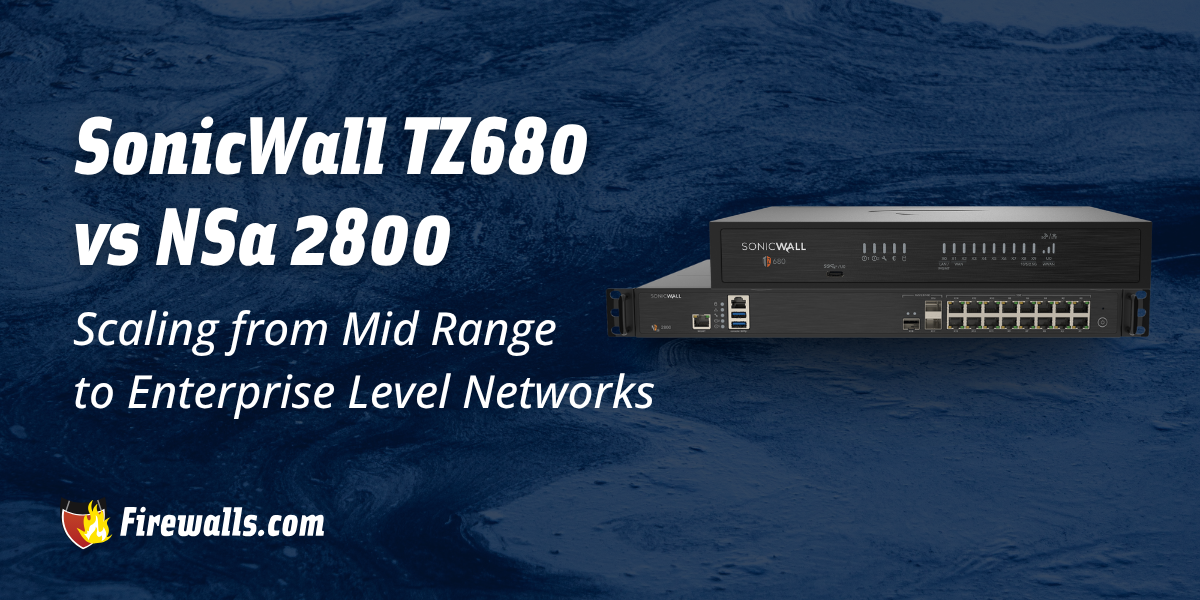
Whether you’re finding your start or upgrading your network security stack, SonicWall TZ 680 vs NSa 2800 firewalls can offer a helpful comparison. All you need is a quick look at SonicWall’s firewall lineup, and it’s pretty clear they have something for every company, big or small.
However, this firewall comparison highlights the realities of a mid-range firewall like the TZ 680 and a highly scalable option like the NSa 2800. This article offers a comparison that you can use as actionable information for your final decision.
Key Takeaways:
- The TZ 680 is well suited for mid-sized companies and advanced branch deployments
- The NSa 2800 delivers greater performance and scalability for demanding networks
- Both firewalls run SonicOS 8 and support centralized management
- You’re getting higher throughput across key security functions with the NSa 2800
- Network size, traffic demands, and future growth plans all play into your decision-making with firewall hardware
Core Differences Between SonicWall TZ Series and NSa Series
Offering a compact desktop architecture, the TZ series is great for smaller companies, branch offices, and distributed operations. With the NSa series, you’re looking at a 1U rack-mounted solution aimed at larger enterprise and campus-level networks.
While both the TZ 680 and NSa 2800 come from the same manufacturer, you’ll definitely find a few differences in their core architecture. The same can be said about a few similarities as well. Nevertheless, the table below offers some clarity on what the architecture looks like between the two SonicWall Gen 8 firewalls.
| Architecture Angle | SonicWall TZ Series | SonicWall NSa Series |
|---|---|---|
| Integrated Capabilities | Firewalling, switching, wireless management, SD-WAN, and cellular failover | Advanced firewalling, networking, SD-WAN, and high availability |
| Deployment & Provisioning | SonicExpress App onboarding and Zero-Touch deployment | Zero-Touch deployment and flexible enterprise provisioning |
| Management | Unified management with Network Security Manager (NSM) and single pane of glass admin | Centralized SaaS and on-prem management through NSM |
| Storage | Built-in and expandable storage up to 512 GB for logging, reporting, caching, and backups | Expandable storage supporting enterprise logging, reporting, and operational requirements |
| Network Resiliency | Cellular failover and optional redundant power on select models | Dual power supplies and Layer 4-7 high availability |
It doesn’t take much reading through the table above to see the slight similarities and differences side by side. Thankfully, SonicWall’s architecture is pretty seamless, which is why scaling through their lineup feels so hassle-free.
Specific features and capabilities mentioned above are important, but what about the core specifications? It’s important for business owners and IT leaders to understand what each individual model can bring to the table, and where the limitations are.

What is the SonicWall TZ 680 Firewall?
The TZ 680 Gen 8 firewall from SonicWall is one that’s optimal for the likes of mid-sized organizations and advanced branch deployments. Moreover, the support of SonicOS 8 offers intrusion prevention, anti-malware, Secure VPN, and much more.
Here’s a brief look at a few surface-level specifications:
- Firewall Throughput: 5 Gbps
- Threat Prevention Throughput: 2.5 Gbps
- App Inspection Throughput: 3 Gbps
- IPsec VPN Throughput: 2.5 Gbps
- Max Connections (SPI): 1,600,000
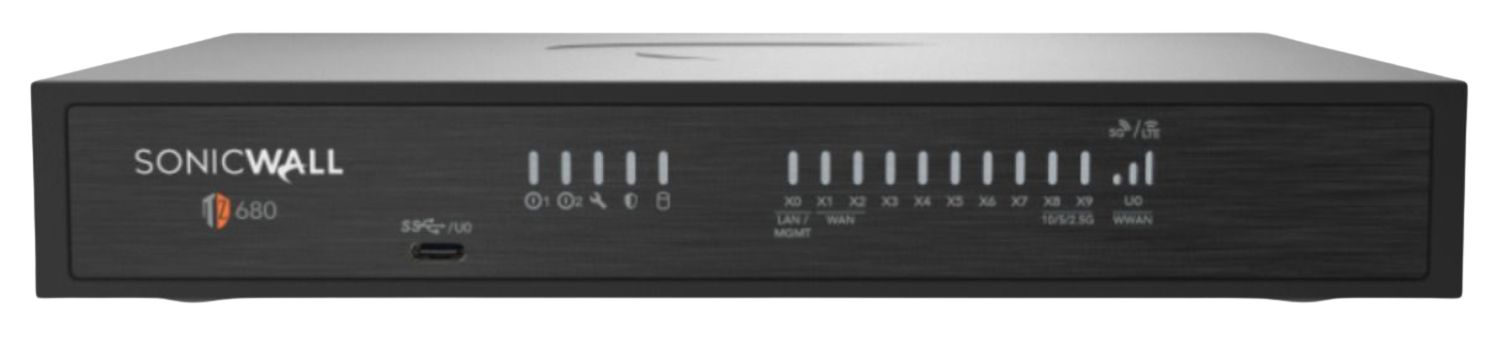
Centralized management is a big winning angle here. Not to mention the optional storage expansion for growing businesses running into larger operational and logging requirements. Similarities aside, how does this exactly compare against the specs of the NSa 2800?
What is the NSa 2800 Firewall from SonicWall?
Leaning more towards the needs of mid-level and enterprise firewall needs, the NSa 2800 is a strong piece of network security hardware. It’s also a Gen 8 model, which means you’re getting the benefits of SonicOS 8 here as well.
Take a quick look at a few comparable specs in the list below:
- Firewall Throughput: 8 Gbps
- Threat Prevention Throughput: 6 Gbps
- App Inspection Throughput: 7 Gbps
- IPsec VPN Throughput: 5.5 Gbps
- Max Connections (SPI): 2,000,000

I won’t deny that you’ll find quite a few similarities when it comes to security features. However, I can’t say the same about the specs, as this is where you’re going to find what really makes them unique.
SonicWall TZ 680 vs NSa 2800 Firewall Comparison
Remember, both the TZ 680 and NSa 2800 are next generation firewall solutions. It’s all about sizing up the unique specs against your real-world network demands, one step at a time. For a bit more supportive material for your decision-making, check out the firewall comparison table below.
| Specifications | SonicWall TZ 680 | SonicWall NSa 2800 |
|---|---|---|
| Firewall Throughput | 5 Gbps | 8 Gbps |
| Threat Prevention Throughput | 2.5 Gbps | 6 Gbps |
| App Inspection Throughput | 3 Gbps | 7 Gbps |
| IPS Throughput | 3 Gbps | 7 Gbps |
| TLS/SSL Inspection & Decryption Throughput | 800 Mbps | 1.8 Gbps |
| IPsec VPN Throughput | 2.5 Gbps | 5.5 Gbps |
| Max Connections (SPI) | 1,600,000 | 2,000,000 |
| Connections per Second | 26,000 | 50,000 |
| Interfaces | 8 x 1GbE 2 x 10G SFP 1 x Console 1 x USB Type-C | 16 x 1GbE 3 x 10G SFP+ 2 x USB 3.0 1 x Console 1 x Management port |
You can see where the NSa 2800 comes out a bit stronger here. Then again, it’s helpful to keep in mind both firewalls focus on entirely different areas.

A Final Word
To better understand which side of the coin you fall on here, it helps to remember the unique differentiating factors. Comparing SonicWall TZ 680 vs NSa 2800, it’s all about knowing their target market and comparing that against your own needs.
Whereas the 680 is best for mid-sized operations and advanced branch deployments, the NSa 2800 is a stronger firewall overall. Making the right choice for your network isn’t one you have to handle all on your own. Think about hopping on a call with our team of network engineers at Firewalls.com and get honest answers about your network situation.
Frequently Asked Questions
What is the Core Difference Between the SonicWall TZ680 and NSa 2800?
The TZ680 focuses on the needs of mid-sized and branch environments. With the NSa 2800, it provides higher performance capabilities and scalability for more demanding networks.
Which Firewall Has Higher Throughput?
It’s the NSa 2800 that has the higher throughput across key areas like firewall, threat prevention, app inspection, and more.
How Many Connections Does the TZ680 Support?
This firewall supports a maximum of 1.6 million SPI connections.
Is the SonicWall NSa 2800 Better for Enterprise Networks?
Yes, its higher performance, 2 million connection capacity, and expanded capabilities make it better suited for more demanding networks.
Should I Choose the TZ 680 or NSa 2800?
Choose the TZ680 if you’re working with branch environments and the NSa 2800 if you’re prioritizing scalability and performance capability.