The topic of choosing the right firewall for your business network can be a technical and convoluted one. However, in the realm of Meraki vs SonicWall solutions, the specifications offer all of the guidance you need.
More specifically, taking a look at two comparable options, such as the TZ480 and MX250, there are plenty of similarities and differences to think about. The reality is that both of these firewall vendors are stellar options for numerous reasons. That’s why this article focuses more on hardware-network alignment, rather than one being better than the other.
Key Takeaways:
- Both SonicWall TZ480 and Cisco Meraki MX250 offer strong enterprise-grade security, but target different business network environments
- TZ480 is ideal for small businesses and remote offices
- MX250 is built for larger campuses and VPN-concentrated networks
- Firewall selection should consider factors beyond specs, including ease of management and long-term network growth
- The best choice depends on aligning hardware capabilities with your current and future network demands
Navigating the Best Firewall Choices for Secure Business Networks
The general aim of firewall hardware is to defend sensitive data and communications from cyber threats. Of course, this doesn’t mean the choices are universal regarding features and capabilities.
Some of the important factors to evaluate include performance, scalability, and overall ease of management. Many modern firewalls come with features like intrusion prevention, anti-malware scanning, and encrypted traffic inspection. However, when it comes down to specific models like the TZ480 SonicWall device and MX250, you’re going to find quite a few differences.
What is the SonicWall NGFW TZ480?
The TZ480 from SonicWall promises enterprise-grade security with a focus on small business network demands. This also comes with a focus on the needs of remote environments and the reliable scope of Gen8 tech for advanced threat protection.
Take a quick overview of the specs in the list below:
- Firewall Throughput: 4 Gbps
- IPS Throughput: 2.2 Gbps
- IPSec VPN Throughput: 2 Gbps
- Site-to-Site VPN Tunnels: 200
- Max Connections (SPI): 1,200,000
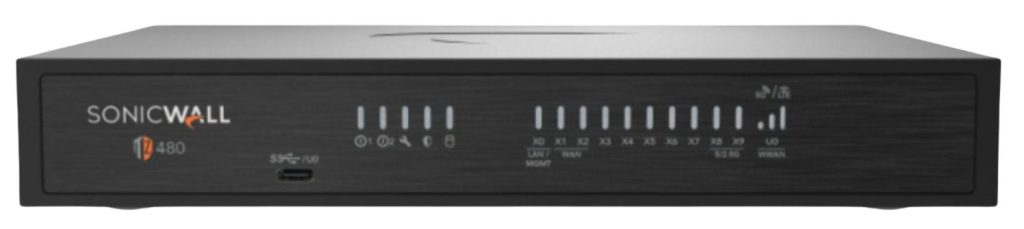
While this is more than enough for many small businesses, that doesn’t mean it’s the perfect choice for everyone. However, it’s a good start considering benefits like zero-touch deployment, simplified network management, and easy traffic monitoring. Nevertheless, a quick comparison to other firewall models helps provide a clearer picture of your options here.
What is the Cisco Meraki Firewall MX250?
Known as a high-performance enterprise firewall, the MX250 from the lineup of Meraki firewalls is rated for 750 to 1,000 users. It protects against a wide range of network threats and comes with a simple and intuitive management interface.
Below offers a quick comparison to the specs listed above:
- Firewall Throughput: 4 Gbps
- Advanced Security Throughput: 2 Gbps
- VPN Throughput: 1 Gbps
- Max VPN Tunnels: 3,000

Although the MX250 may seem like a simpler option, remember it’s more about network alignment than anything else. Depending on what your network needs, this could easily be the best firewall for your particular situation.
An Overview of Meraki vs SonicWall Models MX250 and TZ480
Cisco Meraki and SonicWall are both well-respected, leading network security providers with many scalable solutions. However, that doesn’t mean the differences between two specific models don’t matter. When it comes to the MX250 and TZ480, check out the Meraki vs SonicWall overview in the table below.
| Specifications | SonicWall TZ480 | Cisco Meraki MX250 |
|---|---|---|
| Firewall Throughput (Gbps) | 4 | 4 |
| IPS/Advanced Security Throughput (Gbps) | 2.2 (IPS) | 2 (Adv. Security) |
| VPN Throughput (Gbps) | 2 (IPSec) | 1 |
| Site-to-Site/Max VPN Tunnels | 200 | 3,000 |
| Max Connections (SPI) | 1,200,000 | N/A |
| Target Users | Small businesses and remote environments | Campus and VPN-concentrated business environments |
| Interface | 8 x 1GbE Cu 2 x 5G/2.5G/1G SFP+ 1 console (MicroUSB) 1 USB (type-C) | 1 x GbE RJ45 (WAN) 1 x USB (WAN) 8 x GbE (LAN) 2 x GbE (SFP) (LAN) |
It’s also important to consider factors beyond specifications alone. A few good examples include things like overall ease of use and what the long-term scalability looks like. All in all, both firewalls promise strong protection against cyber threats.
You’ll always have plenty of solutions to choose from in the discussion of Meraki vs SonicWall. However, it’s more important to compare the specs with the current and future demands of your business network.
The Bottom Line
Whereas the SonicWall TZ480 is ideal for small businesses and remote environments, the MX250 is geared toward campus and VPN-concentrated operations. You can breathe easy knowing both firewall vendors offer the support you’re looking for.
As always, regardless of Meraki vs SonicWall, it’s more important to focus on the right firewall pairing with your exact network demands. For those who’d like to learn more about the best firewall options available, reach out to our team at Firewalls.com for all of the support you need.
FAQ
What is the Main Difference Between the SonicWall TZ480 and Meraki MX250?
The TZ480 is designed for small businesses and remote office operations, while the MX250 targets campus-scale and VPN-concentrated networks.
Can the TZ480 Handle Encrypted Traffic Efficiently?
Yes, the TZ480 is built to process encrypted traffic seamlessly, ensuring secure communications without slowing down network performance.
How Many VPN Tunnels Does Each of These Firewalls Support?
The TZ480 supports up to 200 site-to-site VPN tunnels, whereas the MX250 can handle up to 3,000 VPN tunnels.
Which Firewall is Easier to Manage for IT Teams?
Both firewalls offer simplified management, but the TZ480’s zero-touch deployment is ideal for small IT teams. On the other hand, the MX250 provides an intuitive interface suited for larger, more complex enterprise networks.
How Do I Decide Which Firewall is Right for My Business?
Start by considering your network size, number of users, VPN needs, and long-term scope of scalability. TZ480 is great for smaller setups, and the MX250 is better geared toward high-capacity environments.