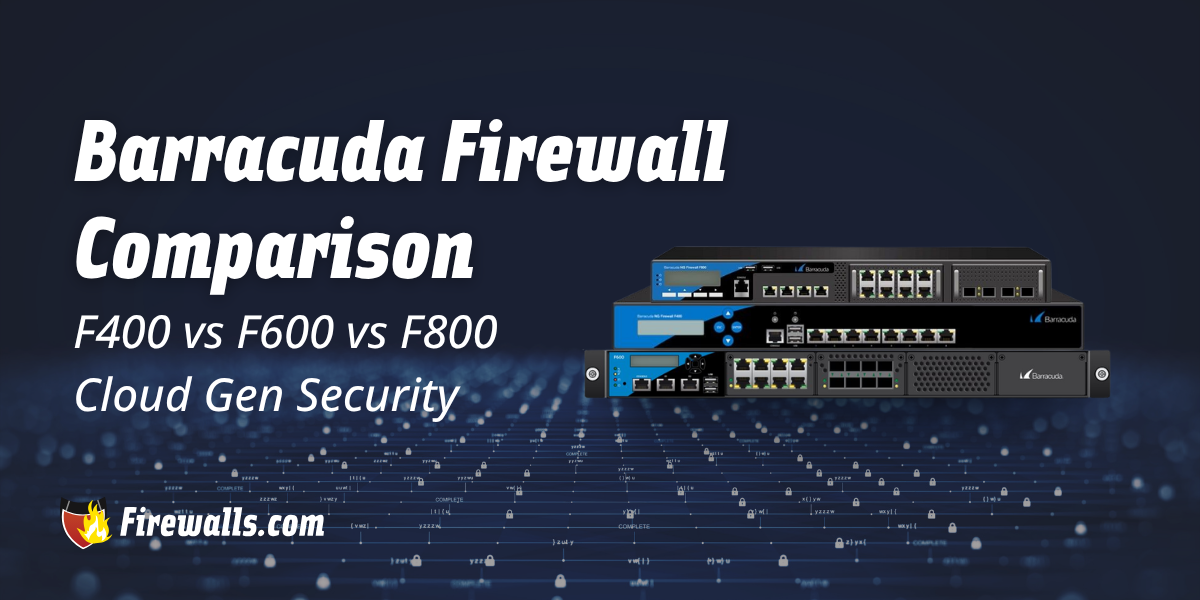
Part of what makes Barracuda firewall options stand out to me is the cloud-based focus of their architecture. Moreover, when you’re looking at the F-Series, know that it’s structured with scalability in mind.
For those sorting through firewall reviews for a range of options, I’ve got several solid options to show you. This article focuses on comparing the F400 vs F600 vs F800 CloudGen firewalls from Barracuda to help you get aligned with the right security hardware.
Key Takeaways:
- Barracuda F-Series performance varies significantly across multiple firewall specifications
- F400, F600, and F800 session capacity ranges from 500,000 to 2.5 million concurrent connections
- CloudGen security features include IPS, app control, antivirus, web filtering, and SSL/TLS interception
- SD-WAN capabilities support app-aware routing, multiple uplinks, traffic shaping, and VPN connectivity
- F-Series scalability provides options for networks with different traffic levels, user counts, and connectivity requirements
Exploring Barracuda Firewall Features and Capabilities
Offering a combination of network security and cloud-based capabilities, Barracuda firewalls are a lot more impressive past the surface. A few core protections I’d like to highlight include app control, stateful packet inspection, IPS, and SSL/TLS interception, to name a few. In addition to that, you’ll find more advanced security features as well, with examples like malware analysis, DNS reputation filtering, and much more.
When you add on the simplicity of centralized management, it’s easy to see how Barracuda CloudGen firewalls meet the needs of modern business networks. Then again, making that your reality is heavily dependent on choosing the right hardware, which is why comparing firewall products is so vital.
What is the Barracuda F400 CloudGen Firewall?
Starting off with the Barracuda F400 firewall, this is considered a mid-range option to say the least. Like other firewalls in the F-Series lineup, you’re getting plenty of cloud-focused support, perfect for a remote workforce or distributed networks.
Here’s a quick look at what you’re getting out of the firewall hardware:
- Firewall Throughput: Up to 9 Gbps
- VPN Throughput: 2.3 Gbps
- IPS Throughput: Up to 3 Gbps
- NGFW Throughput: Up to 3 Gbps
- Max Concurrent Sessions: 500,000

Regarding the Barracuda ecosystem as a whole, this firewall comes with many of the same security features found throughout the F-Series. However, the specs highlight differentiators that are very relevant to overall performance and capability.
What is the Barracuda F600 Firewall?
Another mid-range option from the Barracuda F-Series, the F600 firewall is a little better suited for larger network environments. Essentially, if you’re facing higher traffic demands, the F600 is a step in the right direction.
Check out some of the leading specs from this model in the list below:
- Firewall Throughput: Up to 20 Gbps
- VPN Throughput: Up to 6.8 Gbps
- IPS Throughput: Up to 8 Gbps
- NGFW Throughput: Up to 6.4 Gbps
- Max Concurrent Sessions: 2,100,000

From the high network performance to CloudGen architecture and excellent mid-range support, the F600 is a strong option for many. As always, that doesn’t mean it’s a universal solution for growing, mid-sized organizations. Sometimes, you need something a little stronger that offers a bit more room to grow.
What is the Barracuda F800 Firewall?
Standing on the higher end in this firewall comparison, the F800 is there for the needs of large network environments. This leans more toward the realities of substantial traffic demands, and it’s pretty easy to see in the specs alone.
Check out what the F800 is capable of at a glance:
- Firewall Throughput: 30 Gbps
- VPN Throughput: 7.5 Gbps
- IPS Throughput: 8.3 Gbps
- NGFW Throughput: 7.7 Gbps
- Max Concurrent Sessions: 2,500,000
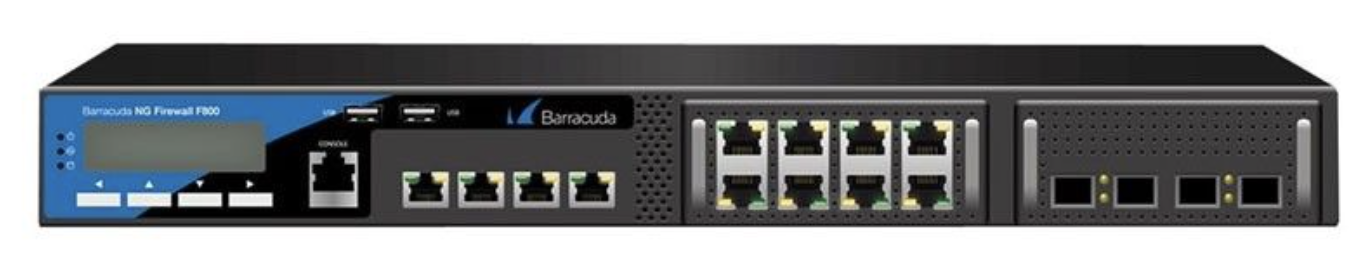
Rated to handle more than 2,500 users on a single network, it’s easy to see the F800 as a powerhouse in comparison. As impressive as the hardware may be on paper, it’s always more important to make sure your network demands are aligned here. One of the best ways to do this effectively is a no-fluff side-by-side comparison of the fine print.
Barracuda F400 vs F600 vs F800 Firewall Comparison
Datasheets are chock-full of helpful information, but it can honestly be a lot to sort through. I’d say this is especially true for those who may not be entirely up to speed on all of the specifics and terminology. Nevertheless, the table below offers helpful details you can use to support your research, comparing Barracuda firewalls F400 vs F600 vs F800.
| Category | Barracuda F400 | Barracuda F600 | Barracuda F800 |
|---|---|---|---|
| Firewall Throughput | 9 Gbps | 20 Gbps | 30 Gbps |
| VPN Throughput | 2.3 Gbps | 6.8 Gbps | 7.5 Gbps |
| IPS Throughput | 3 Gbps | 8 Gbps | 8.3 Gbps |
| NGFW Throughput | 3 Gbps | 6.4 Gbps | 7.7 Gbps |
| Threat Protection Throughput | 2.7 Gbps | 5.8 Gbps | 7.6 Gbps |
| Max Concurrent Sessions | 500,000 | 2,100,000 | 2,500,000 |
| New Sessions per Second | 20,000 | 115,000 | 180,000 |
| Interfaces | 8 x 1 GbE copper 4 x GbE SFP (F20 model only) | 18 x 1 GbE copper 8 x 1 GbE SFP (certain submodels only) 2 x 10 GbE SFP+ (E20 model only) | 24 x 1 GbE copper 8 x 1 GbE SFP (certain submodels only) 4 x 10 GbE SFP+ (certain submodels only) |
I’d like to point out that the specs listed above are all of the highest capabilities among the submodels across F400, F600, and F800 firewalls. That means, depending on which submodel you’re considering, you’ll come across varying specs for each. However, the information above offers a great starting point when it comes to understanding the differences between Barracuda firewall products.

My Final Thoughts
Overall, if you’re looking into getting a Barracuda firewall, comparing the F400, F600, and F800 offers a pretty steep variety. Once you understand the differences, all you have left is the security architecture that they all share.
I’ll be the first one to tell you that these are far from your only options when it comes to reliable firewall hardware. However, if you’d like some extra help on navigating your network security strategy, that’s what our team at Firewalls.com is here for. Outside of the hardware, we can also work by your side on long-term security strategy, proactive strategy, and much more.
Frequently Asked Questions
What is the Main Difference Between the Barracuda F400, F600 and F800?
The core difference between the three can be found in overall performance and connection capacity. In short, the F400 has the lower overall capacity here, and the F600 and F800 deliver progressively higher throughput and session limits.
Which Barracuda CloudGen Firewall Has the Highest Throughput?
Within this specific comparison, the CloudGen F800 has the highest throughput capability, going up to 30 Gbps.
How Many Concurrent Sessions Can the Barracuda F400 Support?
The F400 supports up to 500,000 concurrent sessions.
Do Barracuda Firewalls Come With SD-WAN Support?
Yes, Barracuda firewalls include SD-WAN capabilities, including app-aware routing, multiple uplinks per VPN tunnel, traffic shaping, and more.
Do the F400, F600, and F800 Have the Same Security Features?
They do share the broader CloudGen firewall security set, such as firewalling, IPS, app control, SSL/TLS interception, antivirus, web filtering, and more.