There’s no argument that both Cisco Meraki and Sophos are two of the most trusted firewall manufacturers in the business. However, it can still be challenging for businesses to determine which best aligns with their unique business goals. In the scope of Cisco Meraki vs Sophos, there are plenty of firewall models to choose from. With benefits like high firewall and threat protection throughput, you have to dig a little deeper to discern which route to take.
The choice will always come down to your priorities in network security, and which business firewalls align with those the most. This article focuses on Cisco Meraki vs Sophos, showcasing the similarities and unique differences between the XGS 88 and MX250.
Key Takeaways:
- Sophos XGS 88 is ideal for small businesses and branch offices needing deep security and high throughput
- Cisco Meraki MX250 targets mid to large enterprises with cloud-based management and centralized control
- XGS 88 offers higher firewall and VPN throughput, while MX250 emphasizes scalable deployment and simplicity
- Choosing the right firewall depends on operational needs, management preferences, and long-term scalability
- Both platforms secure modern networks effectively, but each prioritizes different strengths in performance and management
Finding the Firewall Vendor That Works for You
Whether you’re looking at Sophos or Meraki firewalls, choosing a vendor is a strategic decision. This goes beyond specs and benchmark performance alone. The right firewall should align with not only network security demands, but your daily workflows and operational expectations.
Understanding whether you need flexibility, ease of management, or a balance of the two is critical to the whole picture here. Aside from that, long-term factors matter too, such as scalability, licensing needs, and overall ecosystem support. This isn’t about one vendor being better than the other, but what their focal points are when it comes to the firewall hardware.
What is the Sophos XGS 88
Built as a scalable option for small businesses and branch offices, the XGS 88 Sophos firewall is optimized for cloud-heavy and encrypted network traffic. Moreover, this comes with the promise of advanced threat defense, including deep packet inspection and full TLS 1.3 inspection.
Here’s a quick look at a few notable specifications:
- Firewall Throughput: 9.9 Gbps
- IPS Throughput: 2 Gbps
- Threat Protection Throughput: 2 Gbps
- IPsec VPN Throughput: 6 Gbps
- Concurrent Connections: 1,600,000
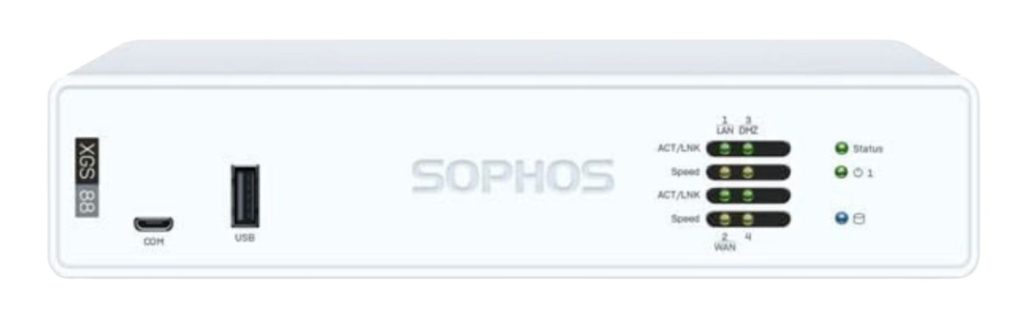
It’s also a fanless design, making it a great option for businesses that are a bit constrained on space. Nevertheless, it doesn’t make it a universally perfect option for every small company.
What is the Cisco Meraki Firewall MX250?
Aimed at mid to large-scale enterprise networks, the MX250 Cisco Meraki firewall is a diverse option in its own right. Rated for up to 1,000 users, it utilizes a cloud-based dashboard, offering centralized visibility, policy control, and more.
Here’s a quick comparison with a few surface-level specs:
- Firewall Throughput: 4 Gbps
- Advanced Security Throughput: 2 Gbps
- Max VPN Throughput: 1 Gbps
- Concurrent VPN Tunnels: 3,000
- Web Caching: 128 GB

Once again, it’s important to stack up this information against the unique demands of your business network security. Considering all of the technical lingo, it doesn’t hurt to streamline your understanding where possible.
Cisco Meraki vs Sophos Firewall Comparison
All in all, each of these firewall vendors leans into varying philosophies when it comes to firewall hardware. However, both platforms are able to secure modern, high-traffic networks, but prioritize different strengths. You can get a straightforward look at this in the table below.
| Specifications | Sophos XGS 88 | Cisco Meraki MX250 |
|---|---|---|
| Target Audience | Small businesses and branch offices | Mid to large-scale enterprises |
| Firewall Throughput (Gbps) | 9.9 | 4 |
| Threat / Advanced Security Throughput (Gbps) | 2 | 2 |
| IPsec VPN Throughput / Max VPN (Gbps) | 6 | 1 |
| Concurrent Connections / VPN Tunnels | 1,600,000 | 3,000 |
| Storage / Caching | 16 GB eMMC | 128 GB |
| Interface | 4 x 2.5 GE copper 1 x COM RJ45 1 x Micro-USB 1 x USB 2.0 1 x USB 3.0 | 2 x 10GbE SFP+ 1 x USB 8 x GbE (RJ45) 8 x GbE (SFP) 8 x 10GbE (SFP+) |
This firewall comparison helps you identify which platform best fits specific network needs and operational priorities. While these are far from the only options available, they offer a good look at two sides of the coin with trusted firewall solutions.
The Final Word
In this particular comparison of Cisco Meraki vs Sophos, you’re getting a varied look at deep inspection, high throughput, scalability, cloud-based management, and more. Regardless of which firewall you end up with, it’s always crucial to consider long-term factors.
There is no universally “better” option here, as it’ll always come down to what makes the most sense for your current and future network demands. Nevertheless, the team at Firewalls.com is here if you need to fine-tune your search a bit further on the best firewall solutions. Feel free to reach out to us for a one-on-one that will help point you in the right direction.
FAQ
What Types of Businesses are Best Suited for Sophos XGS 88?
Small businesses and branch offices that need advanced threat protection, high throughput, and a compact, fanless design.
Who Should Consider the Cisco Meraki MX250 Firewall?
Mid to large-scale enterprises looking for cloud-based management, centralized control, and scalable deployment across multiple sites.
How does the Firewall Throughput Compare Between Sophos XGS 88 and Meraki MX250?
The XGS 88 offers up to 9.9 Gbps firewall throughput, while the MX250 provides 4 Gbps, with both supporting 2 Gbps for advanced threat protection.
Does Either Firewall Prioritize Management Simplicity Over Deep Inspection?
Yes, Meraki focuses on simplified, cloud-based management, whereas Sophos focuses on deep packet inspection and granular on-box security controls.
How Should Companies Choose Between These Two Firewalls?
Consider your network size, management preferences, performance needs, and long-term scalability to determine which aligns best with your operational goals.