This goes for any growing business; you’re bound to go through a next generation firewall comparison eventually. Scaling is just a part of growing a business, and that same sentiment should go toward your network security stack.
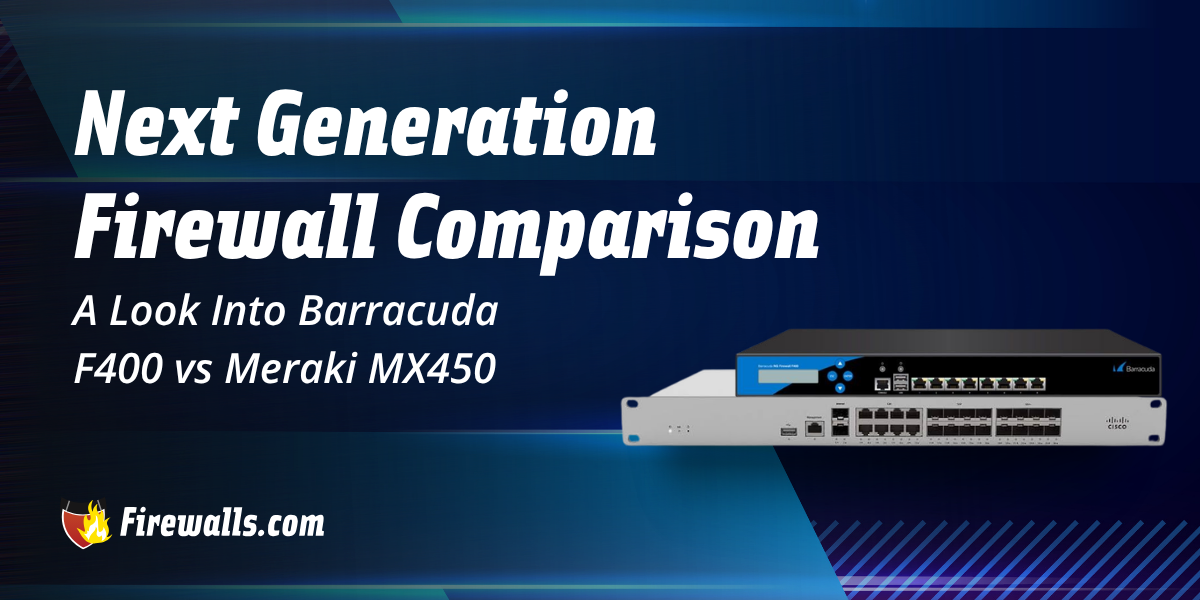
In the comparison of the Barracuda F400 vs Meraki MX450, both deliver strong security and simplified management. However, this article will be more focused on how the specs differ and where they land when it comes to specific network demands.
Key Takeaways:
- The Barracuda F400 is designed for mid-sized environments, supporting roughly 501-750 users
- The Meraki MX450 is built for larger networks, supporting a range of 1,000 to 2,500 users
- Both firewalls come with strong core performance, but differ in throughput distribution across multiple layers
- Architecture approaches vary, with the F400 emphasizing sandboxing and inspection and the MX450 focusing on cloud policy enforcement
- Interface design and scaling options differ significantly, impacting how each model fits into your network expansion and deployment
The Importance of Next Generation Firewall Comparisons
If you want to end up with the right security hardware, you’ll need to align security design with real-world network behavior. This includes your existing network demands and how you expect to potentially expand in the coming years.
For many organizations, real traffic patterns are shaped by things like distributed endpoints, remote workforces, and cloud applications. This comparison between the Barracuda F400 and Cisco Meraki MX450 will help offer some clarity on how these solutions perform from more than one angle.
What is the Barracuda F400?
For those looking into Barracuda security options, the F400 is built for mid-sized environments. Moreover, the firewall is able to support business networks ranging from 501 to 750 users.
Here’s a quick overview of what the specs look like for the F400:
- Firewall Throughput: 7.1 Gbps
- VPN Throughput: 2.3 Gbps
- IPS Throughput: 2.8 Gbps
- Threat Protection Throughput: 2 Gbps
- Concurrent Sessions: 500,000

I also find it important to note that the F400 uses cloud-based sandboxing, which helps with deeper analysis of advanced threats. Nevertheless, the firewall is designed to improve scalability, redundancy, as well as centralized network management.
What is the Cisco Meraki MX450?
Among the range of Cisco Meraki firewalls, the MX450 stands out as a large enterprise solution. This particular model supports 1,000 to 2,500 users on a network and is aimed at the needs of high-traffic, large-scale networks.
Here are a handful of top-level specs for a bit more context:
- Firewall Throughput: 6 Gbps
- VPN Throughput: 2 Gbps
- Advanced Security Throughput: 4 Gbps

Of course, these are just a few examples, but there are many other layers to both firewall models. The MX450 makes use of a simple cloud-managed interface, and there are several licensing options to help expand on its security capabilities.
Barracuda F400 vs Meraki MX450 Firewall Comparisons
I always find it easier to put the most important details side by side instead of having to scour separate datasheets. Comparing the Barracuda F400 vs Meraki MX450 mainly differs in architecture and approach to scaling. For a simplified overview, check out the table below for a few leading differences between the two firewalls.
| Specifications | Barracuda F400 | Meraki MX450 |
|---|---|---|
| Firewall Throughput | 7.1 Gbps | 6 Gbps |
| VPN Throughput | 2.3 Gbps | 2 Gbps |
| Recommended User Count | 501-750 | 1,000-2,500 |
| Threat Protection Throughput | 2 Gbps | N/A |
| Advanced Security Throughput | N/A | 4 Gbps |
| Concurrent Sessions | 500,000 | N/A |
| Max Concurrent VPN Tunnels | N/A | 5,000 |
| Interfaces | 8 x 1GbE | WAN: 2 x 10GbE SFP+ LAN: 8 x GbE RJ45 8 x GbE SFP 8 x 10GbE SFP+ |
Whereas the Meraki MX450 focuses on large enterprise deployments, the F400 is more geared toward flexibility for smaller, but growing environments. It’s not about which firewall is better than the other, but aligning the solutions with your realistic network demands.
Final Thoughts
Finding where your network lands between Barracuda products and solutions from Meraki will be a blend of your current and future network scale. The short version of this next generation firewall comparison is that the F400 is for mid-market environments, and the MX450 is more enterprise-level operations.
As I always find it helpful to suggest, our team at Firewalls.com is here with the guidance and firewall solutions your business network needs. Come have a chat with our team, avoid the hassle, and maintain a proactive security stack.
When Does User Growth Affect the Decision Toward Higher Capacity Models?
This happens when scaling requires supporting more users per site or across multiple sites, capacity and distribution needs become leading factors.
How is Traffic Inspection Handled Differently Under Load?
The F400 uses layered inspection with cloud-offload sandboxing, while the Mx450 uses integrated cloud-managed security services.
What Role Does Interface Design Play in Deployment Planning?
The MX450 has a defined high-density interface layout, while the F400 varies based on model configuration and use case.
What are the Differences in Security Architecture Approach?
With the F400, you’re getting layered inspection with sandboxing and behavioral analysis. On the MX450 side, it heavily relies on cloud-managed policy enforcement and integrated security services.
How Do the User Capacity Ranges Differ Between the Two Models?
In the F400, you’ll find support for roughly 501 to 750 users, and support for 1,000 to 2,500 users when it comes to the MX450.