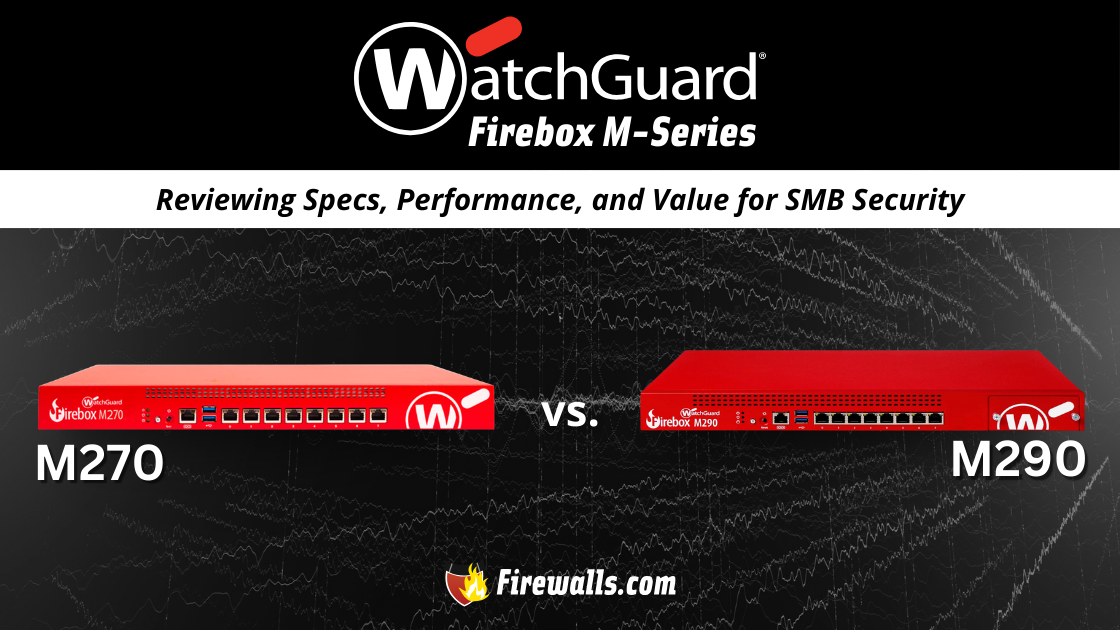
Small businesses are some of the biggest targets when it comes to cybersecurity threats. While there’s no shortage of network security providers to choose from, you want to make sure you end up with the right hardware for your needs. In the context of WatchGuard M270 vs M290, it’s important to understand their differences and which is the most progressive choice here.
Between firewall features, end-of-life (EOL) dates, and your own network demands, there are quite a few specs to sort through. This article gets straight to the point on the differences in these two closely related firewall models, and why it’s helpful to have your sights set on the future.
WatchGuard M270 vs M290 Review
Although both of these firewalls are geared toward small to mid-size organizations, their features and capabilities are enterprise-grade. Sure, you’re bound to find a few similarities here, but there are also several stark differences that’ll end up guiding your decision-making.
Thankfully, you don’t have to worry about end-of-life dates just yet. The M270 might have met its end-of-sale in July of 2023, but its EOL won’t get here until July 2028. Better yet, the M290 has no announcement for either of these dates, promising your network years of support without having to worry about an upgrade. Nevertheless, getting into their specifics will help you determine which route you’ll need to take.
What is the WatchGuard M270 Firewall?
From the perimeter to every endpoint, the M270 is well-versed in enterprise-grade prevention and detection. You’re also getting multi-core processors from Intel, and a wide range of necessary insights into your network security as a whole.
Regarding the fine print, this is where the WatchGuard firewall stands:
- Firewall Throughput: 4.9 Gbps
- VPN Throughput: 1.6 Gbps
- IPS Throughput: 2.3 Gbps
- UTM Throughput: 1.6 Gbps
- Concurrent Connections: 2,000,000

The capability seems pretty steep on their own, but it’s more about how this compares to newer scales in WatchGuard security, like the M290. Of course, this isn’t to say the M270 is obsolete just because newer models exist, but it does factor into how it aligns with your current network demands.
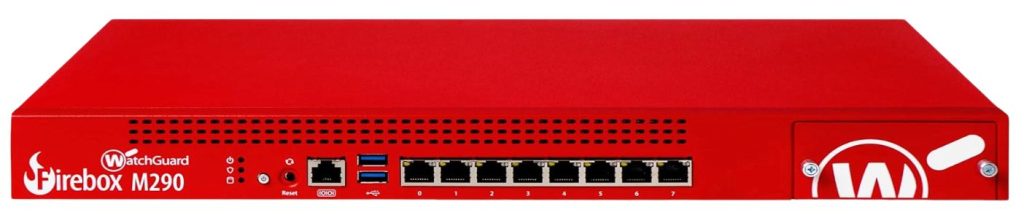
What is the M290 WatchGuard Firewall?
Also built with small businesses in mind, the M290 also has a focus on what’s needed in today’s cybersecurity landscape. There are numerous WatchGuard technologies that you could choose from, but the M290 hits a sweet spot in more ways than one.
Here’s how the network security firewall compares to the M270:
- Firewall Throughput: 5.8 Gbps
- VPN Throughput: 2.4 Gbps
- IPS Throughput: 1.3 Gbps
- UTM Throughput: 2.4 Gbps
- Concurrent Connections: 3,500,000
If you know anything about firewall tech, then you’re well aware that both of these models have a lot more to offer than these specs alone. They act as a good quick reference point, but it’s always a good idea to get into the details a little further for a more comprehensive view.
WatchGuard M270 vs M290 Direct Comparison
To help save you a bit of time, the table below focuses on several key specifications between the firewall models. Sorting through every word in a datasheet can make decision-making a bit convoluted. The information below should offer some clarity and act as a great reference point you can always come back to.
| Specifications | WatchGuard M270 | WatchGuard M290 |
|---|---|---|
| Firewall Throughput (Gbps) | 4.9 | 5.8 |
| VPN Throughput (Gbps) | 1.6 | 2.4 |
| IPS Throughput (Gbps) | 2.3 | 1.3 |
| UTM Throughput (Gbps) | 1.6 | 2.4 |
| Concurrent Connections | 2,000,000 | 3,500,000 |
| New Connections per Second | 40,000 | 34,000 |
| HTTPS Content Inspection (Mbps) | 480 | 696 |
| AntiVirus (Gbps) | 2.1 | 1.47 |
As you can see, depending on the category, the scales sway here and there, but it’s also about the features involved with the hardware. Both of these still have viability on the market. However, when it comes to planning ahead, it’s inevitable that the M290 will outlive the M270.
The Bottom Line
Making a choice on which hardware firewall is best can feel nerve-wrecking, as it’s a pretty long-term investment. If you’re an existing user or newcomer to WatchGuard technologies, it’s understandable that you want to feel like you’re making the right choice.
Both of these firewall models share some similarities, but the key differences are undeniable. Especially the further you read into the technical data. To help avoid some trial and error, consider reaching out to us at Firewalls for a no-fluff opinion on which firewall solution is best for your specific circumstances.