If you’ve ever looked into WatchGuard firewalls before, then you know they have a wide range of options for various business network environments. Their firewalls range from smaller to enterprise-level networks, with a seamless security ecosystem to match.
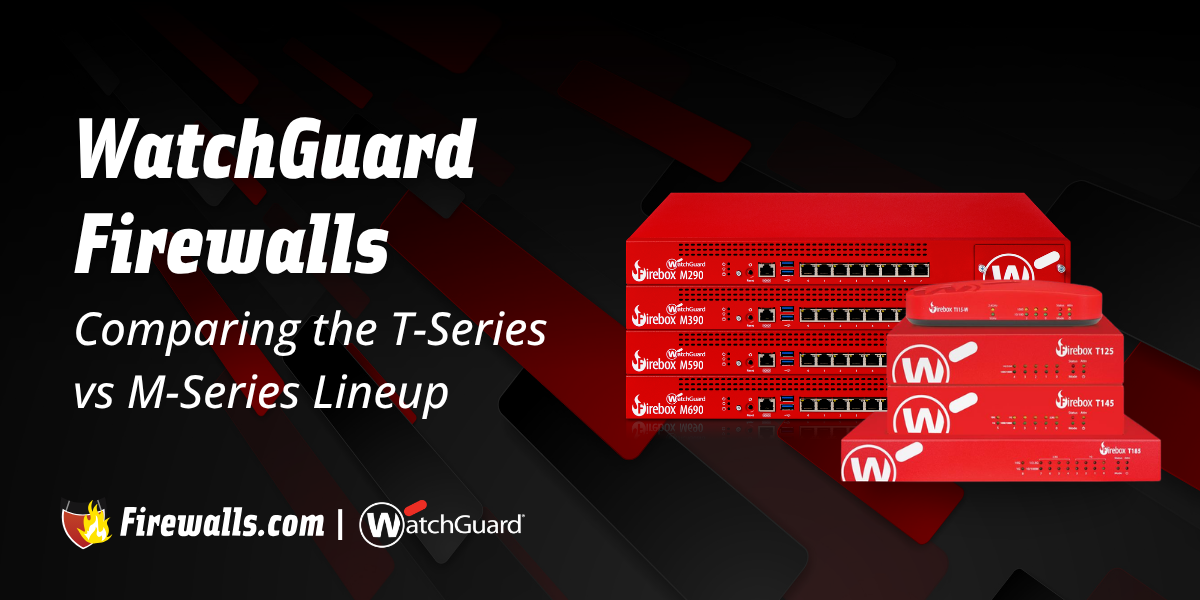
If you’re looking to make a choice, then you’ll need to understand the full variety of what their hardware is built for. This article offers a summarized look at the business firewall options from WatchGuard between the T-Series and M-Series lineups.
Key Takeaways:
- T-Series Firebox appliances use a compact desktop form factor for space-conscious deployments
- M-Series firewalls use a rackmount design for larger network infrastructure
- The T185 reaches 5.7 Gbps firewall throughput, making it the top T-Series option
- The M6850 reaches 104 Gbps firewall throughput, offering enterprise-level protection
- Compare network capacity and scalability rather than choosing solely based on your business size
WatchGuard Firewalls at a Glance
Regardless of which series you’re considering from WatchGuard, both can deliver substantial business network protection. However, what you’re trying to weigh here is the specifics in features, specs, and deployment.
For starters, the T-Series is known for its compact desktop approach. The compact form factor is a big selling point for smaller operations, or those who aren’t working with a dedicated IT team.
On the other side of this, you have the M-Series, which includes rackmount designs, focusing on more enterprise-level support. Instead of listing every single model, I’m going to offer a range of options from both sides of Firebox WatchGuard appliances.
WatchGuard T-Series Compact Business Firewall
If you’re operating within a smaller to mid-size business environment, I’d say you would lean more toward the T-Series. The desktop form factor is great for smaller offices or those simply looking for an overall space-conscious deployment. In the table below, you can gain a general idea of the range that comes with these WatchGuard firewalls.
This gives you an idea of what you’re working with, and the scalability any growing business needs. In the spirit of any other firewall comparison, you want to dig a bit deeper, even if this seems like more than enough. There’s more than one reason the M-Series exists, and the numbers always help showcase the differences.
M-Series Higher-Performance WatchGuard Firewalls
If you feel like your network demands are closer to what the M-Series has to offer, you’re in good hands on this side too. The table below highlights several performance and capacity specs you can compare against the T-Series hardware.
Even with this information alone, it’s easy to tell how these firewalls would be relevant for larger networks. Don’t get me wrong, that’s a pretty vast jump, meaning you have plenty of space to grow with one of the most well-known firewall vendors on the market.
Which Series of WatchGuard Firewalls is Right for You?
The short version is that T-Series firewalls are great for the smaller offices that need hardware they can grow with. Of course, you still have multiple performance levels to choose from here, giving those just starting out the flexibility they need.
With the M-Series, you’re dealing with the midsize to distributed enterprise crowd. The specs I laid out above show you the steep range in this lineup alone. Nevertheless, if you’re trying to get aligned with the right side, there are several steps you’ll need to consider internally.
- Profile your network by reviewing bandwidth, traffic, connected devices, and applications
- Compare firewall and VPN throughput, connections, VPN tunnels, and VLAN requirements
- Plan for growth by thinking about future needs around bandwidth, user support, locations, segmentation, and remote access
- Determine whether the T-Series or M-Series better matches your range in overall requirements
- Select a model that can handle expected demand without biting off more than you can chew
At the end of the day, once you get close to the right firewall model, know that WatchGuard has the room you need to grow securely. You also don’t want to overlook the ecosystem as a whole, which includes a range of forward-thinking security features.

Let’s Wrap Up
The T-Series and M-Series WatchGuard firewalls are meant to serve different network demands. With the T-Series, it emphasizes compact deployment and management, while the M-Series leans into greater overall performance.
Once again, comparing your real-world network demands to the specs and scalability of the hardware is how you end up on the right path. You can also rely on our team of network engineers at Firewalls.com for straightforward advice on which model is best for your operation.
Frequently Asked Questions
What is the Main Difference Between T-Series and M-Series Firewalls?
The T-Series focuses on compact desktop appliances with the needs of smaller organizations in mind, while the M-Series is geared toward substantially higher performance.
Is the WatchGuard T-Series Suitable for a Growing Business?
Yes, the T-Series models have a sizable range of firewall and VPN throughput specs in the lineup, giving you plenty of room to grow.
When Should a Business Consider a WatchGuard M-Series Firewall?
The M-Series makes more sense when your network starts to surpass what the top-level T-Series models are capable of.
Which WatchGuard Firebox Has the Highest Firewall Throughput?
Among the models covered here, the M6850 has the highest firewall throughput out of them all.
What Should Businesses Consider When Choosing Between WatchGuard Firewall Models?
Consider angles such as VPN and firewall throughput, as well as concurrent connections, Branch Office VPN tunnels, VLAN requirements, and deployment environment.