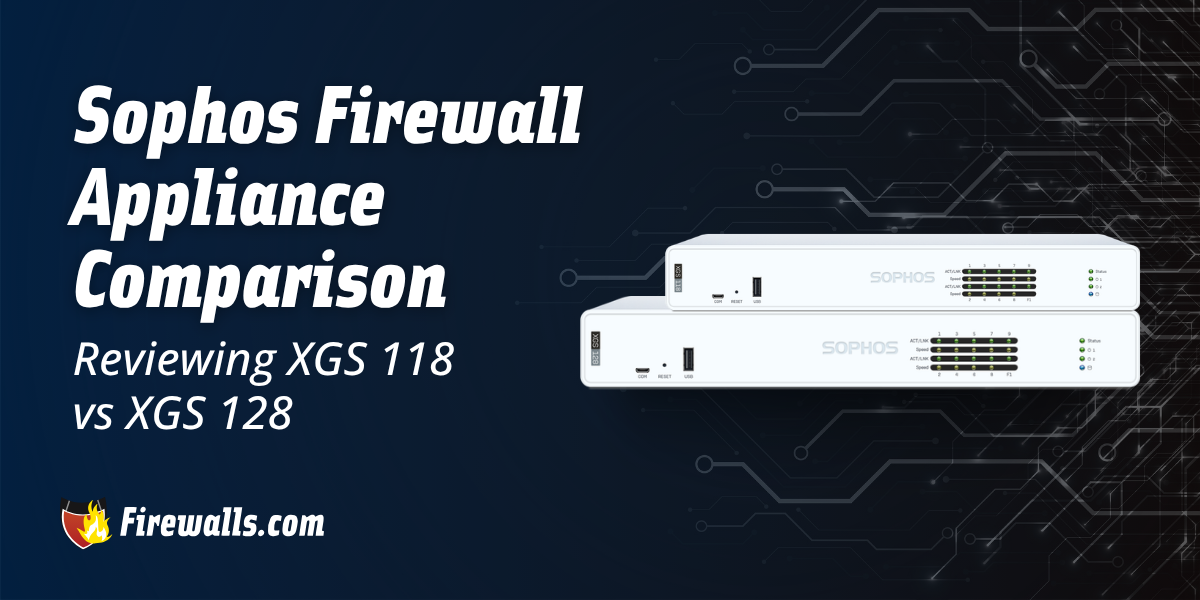
For those of you on the hunt for a compact firewall solution, it’s worth considering a Sophos firewall appliance. However, they have more than just a handful of compact business firewalls on hand, so you’ll need to sort through some firewall comparisons.
More specifically, comparing the Sophos XGS 118 vs XGS 128 puts you in a close yet varied range of specs and features to think about. In this article, I provide a no-fluff comparison between the two, comparing core details you’ll want to know about before making a choice.
Key Takeaways:
- XGS 118 delivers 15.5 Gbps of firewall throughput
- The XGS 128 raises the firewall throughput up to 19.1 Gbps
- Both models support Sophos Xstream architecture and centralized security management
- Identical interface configurations make performance the key differentiator
- XGS 128 supports six million concurrent connections, compared to the XGS 118’s 5.5 million
Navigating the Compact Sophos XGS Firewalls Lineup
Aside from the compact focus of the XGS 118 and 128, the XGS series as a whole is built for scalability. While your business continues to grow, Sophos makes it easy to hop into the firewall hardware that’s right for your operation.
Don’t let the small nature of these firewalls fool you, as the layered security capabilities are all there. This includes combined features like IPS, TLS inspection, Sophos Fusion formerly Sophos Central, management, and firewall protection, of course.
Nevertheless, finding the right firewall for your current situation and near future requires navigating a few nuances between individual models. The XGS 118 and XGS 128 share the same broader ecosystem, but I’m here to show you where the differences are.
What is the Sophos XGS 118 Firewall?
I can agree that its compact design is a part of the upside here, but I can also agree that the specifications are a lot more impressive. For the XGS 118 from Sophos, you’re getting a silent desktop firewall, great for small operations and even branch sites.
Here’s a brief overview of what this firewall is capable of:
- Firewall Throughput: 15.5 Gbps
- Threat Protection Throughput: 3.25 Gbps
- NGFW Throughput: 3.95 Gbps
- IPS Throughput: 3.5 Gbps
- Concurrent Connections: 5,500,000

When it comes to the management side, I highly suggest getting familiar with everything Sophos Fusion, formerly Sophos Central brings to the table. Overall, the XGS 118 is what many small operations need for firewall security, with plenty of wiggle room to grow into.
What is the Sophos XGS 128 Firewall?
Although the XGS 128 is a great starting option for many, I also like to paint the picture of a stepping stone here. It comes from the same Sophos ecosystem, but you’ll find the specs come in a bit stronger for the needs of small to mid-size companies.
You can find a few comparable specs in the list below:
- Firewall Throughput: 19.1 Gbps
- Threat Protection Throughput: 4 Gbps
- NGFW Throughput: 4.35 Gbps
- IPS Throughput: 4.65 Gbps
- Concurrent Connections: 6,000,000

From these specs alone, you can see how they make room for you to scale through their lineup seamlessly. Of course, a next generation firewall comparison requires understanding more than just a few surface-level hardware specs.
Sophos Firewall Appliance Comparison XGS 118 vs XGS 128
Meeting the networking demands of small to mid-size operations, the Sophos XGS 118 vs XGS 128 comparison is more about the fine print than anything else. Aligning your network and organization with the right hardware means getting a good look at the real numbers side by side. Use the table below as your leading reference point for your decision-making between the two.
| Specifications | Sophos XGS 118 | Sophos XGS 128 |
|---|---|---|
| Firewall Throughput | 15.5 Gbps | 19.1 Gbps |
| IPS Throughput | 3.5 Gbps | 4.65 Gbps |
| Threat Protection Throughput | 3.25 Gbps | 4 Gbps |
| NGFW Throughput | 3.95 Gbps | 4.35 Gbps |
| Concurrent Connections | 5,500,000 | 6,000,000 |
| New Connections per Second | 62,650 | 72,250 |
| Xstream SSL/TLS Inspection | 1.1 Gbps | 1.45 Gbps |
| Storage | 64 GB UFS 2.1 | 64 GB UFS 2.1 |
| Interface Details | 9 x 2.5 GbE copper ports 1 x SFP fiber 1 x COM RJ45 1 x Micro-USB 1 x USB 2.0 1 x USB 3.0 1 x Expansion slot | 9 x 2.5 GbE copper ports 1 x SFP fiber 1 x COM RJ45 1 x Micro-USB 1 x USB 2.0 1 x USB 3.0 1 x Expansion slot |
From here, you take this information, and you size it up against your real-world network demands. Add a little hindsight to the mix, and you’ll end up with a Sophos firewall appliance that can provide years of reliable support.

A Final Word
If you’re a smaller operation looking to compare a Sophos firewall appliance or two, starting with XGS 118 vs XGS 128 isn’t a bad start. Both models share the same general interface details and overall architecture.
Scaling isn’t something you have to worry about here; the main focus is the fine print and how that correlates to your current situation. Then again, our team at Firewalls.com is here with the direct answers when you need them. Hop on a brief call with our team and avoid any trial and error with your security stack.
Frequently Asked Questions
How Much More Performance Does the XGS 128 Provide Over the XGS 118?
The XGS 128 reaches 19.1 Gbps when it comes to firewall throughput, versus the 15.5 Gbps on the XGS 118.
What Type of Network is the XGS 118 Best Suited For?
You’ll find that the XGS 118 is more than equipped for the likes of small offices, retail locations, and those juggling branch sites.
When Does the Additional Capacity of the XGS 128 Become Useful?
The extra capacity can benefit your operation if you’re experiencing growing traffic demands or more connected devices, for example.
Are There Any Major Connectivity Differences Between the XGS Models?
No, the XGS 118 and XGS 128 come with the same interface configurations, which notably also include one expansion slot if you need it.
Do Both Sophos Firewall Appliances Fit Into the Broader Security Ecosystem?
Yes, both of these Sophos XGS models operate within the Xstream architecture and can easily integrate with the broader Sophos security ecosystem as a whole.